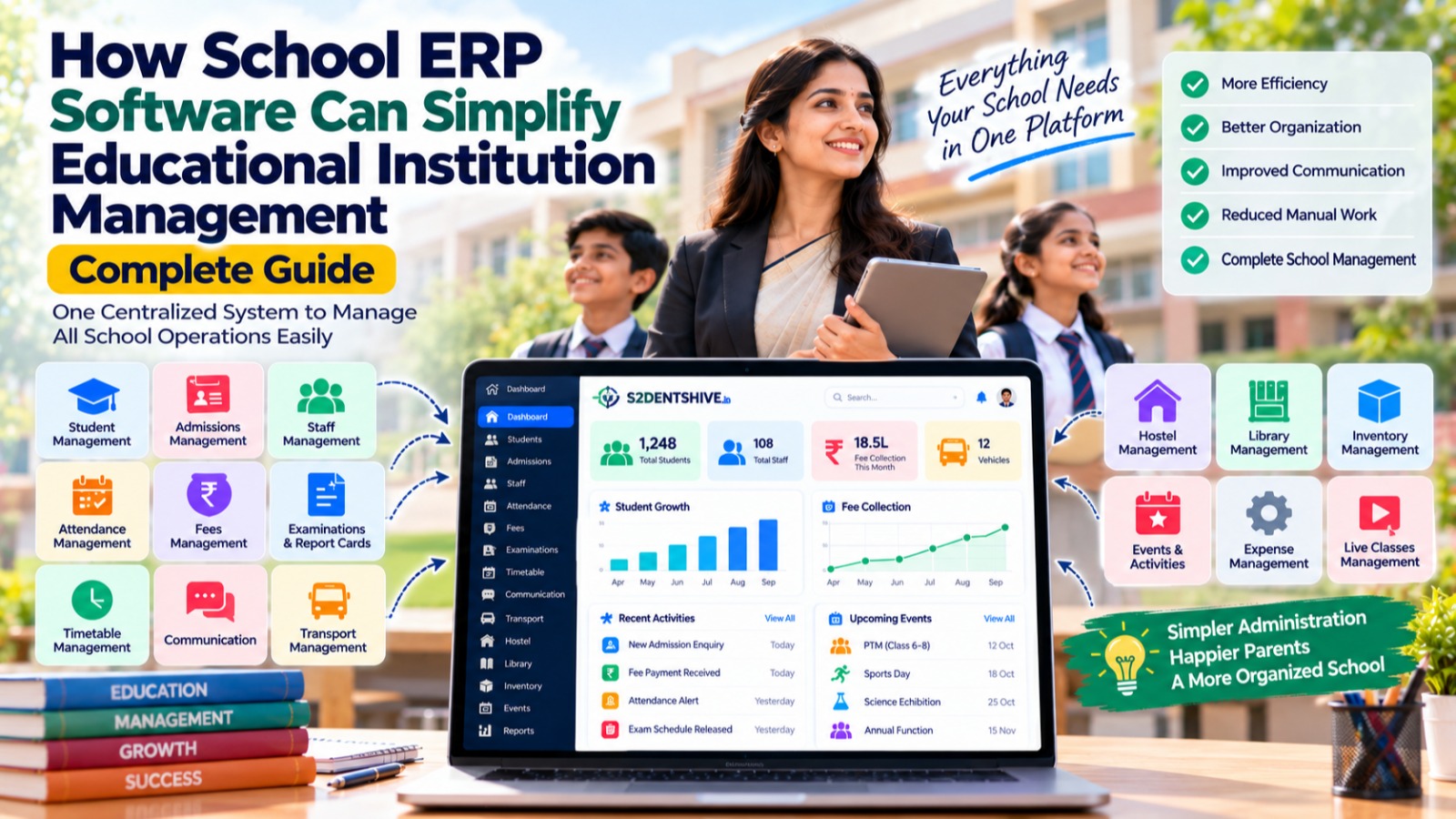

Managing an educational institution involves hundreds of activities every day. School owners, principals, teachers, accountants, administrative staff, transport managers, hostel staff, and other employees all work together to keep the institution running smoothly.
Traditionally, many schools manage these activities using paper registers, Excel spreadsheets, separate software applications, and different communication platforms. While these methods may work when an institution is small, they can become difficult to manage as the number of students, staff, classes, and daily transactions increases.
School ERP Software provides a centralized digital solution that brings different areas of school management together.
From student admissions and attendance to fees, examinations, timetable, communication, transport, hostel, library, inventory, and reports, a School ERP can help educational institutions manage their operations from one connected platform.
S2DENTSHIVE provides a centralized School ERP that brings multiple educational institution management functions together, helping schools reduce dependency on multiple disconnected applications and organize their daily operations more efficiently.
What Is School ERP Software?
School ERP, or School Enterprise Resource Planning Software, is a centralized software platform designed to manage different academic, administrative, financial, and operational activities of an educational institution.
Instead of using separate applications for different departments, a School ERP connects these functions through one system.
A comprehensive School ERP may include:
- Student Management
- Admission Management
- Staff Management
- Attendance
- Camera Attendance
- Fees Management
- Examination Management
- Report Cards
- Timetable Management
- Homework and Assignments
- Communication
- Transport Management
- Hostel Management
- Library Management
- Inventory Management
- Events and Activities
- Expense Management
- Reports and Dashboards
- Live Classes
The main purpose is to create a centralized digital environment for school management.
Why Is Educational Institution Management Becoming More Complex?
Modern schools manage significantly more information than simply student names and attendance registers.
A typical institution may need to manage:
- Thousands of student records
- Parent and guardian information
- Teacher and staff records
- Admission enquiries
- Fee structures
- Online payments
- Attendance
- Examination marks
- Report cards
- Timetables
- Homework
- School events
- Transport routes
- Hostel rooms and beds
- Library books
- Inventory
- Expenses
- Communication
When each department uses a separate system, administrators often have to enter and maintain the same information multiple times.
This creates unnecessary administrative work.
How School ERP Software Simplifies Educational Institution Management
A centralized School ERP can simplify school administration in several ways.
1. Centralized Student Management
Student information is at the center of many school processes.
A School ERP can maintain a central student profile containing information such as:
- Student name
- Admission number
- Class
- Section
- Date of birth
- Parent/guardian
- Contact information
- Documents
- Academic information
- Student status
The same student information can then be used across different modules.
For example:
Student → Attendance → Fees → Examination → Report Card → Communication
This reduces duplicate data entry.
2. Simplifies the Admission Process
Admissions can involve multiple stages.
A school may need to manage:
Enquiry → Application → Documents → Interview → Entrance Test → Admission → Enrollment
A School ERP can organize these activities digitally.
Admission management can include:
- Enquiries
- Admission forms
- Follow-ups
- Document collection
- Interviews
- Entrance tests
- Admission fees
- Enrollment
- Admission reports
Once a student is admitted, the information can be transferred into the main student management system instead of being entered again.
3. Makes Staff Management Easier
Schools have both teaching and non-teaching employees.
A School ERP can maintain centralized staff information including:
- Teacher profiles
- Employee details
- Departments
- Designations
- Roles
- Permissions
- Staff attendance
- Leave
- Teacher assignments
- Employment information
Teacher information can also be connected with:
- Subjects
- Classes
- Sections
- Timetable
- Attendance
- Academic responsibilities
This creates a connected staff management workflow.
4. Simplifies Attendance Management
Attendance is one of the most frequent tasks performed by schools.
A School ERP can help manage:
- Student attendance
- Staff attendance
- Daily attendance
- Absence
- Late attendance
- Half-day attendance
- Leave
- Attendance reports
Depending on the system and configuration, schools may also use digital methods such as camera-based attendance.
Attendance can also be connected with communication.
For example:
Student marked absent → Parent notification
This reduces the need for manual follow-up.
5. Makes Fee Management More Efficient
Fee collection is one of the most important administrative functions of a school.
A School ERP can help manage:
- Fee structures
- Fee groups
- Fee types
- Student-wise fees
- Installments
- Discounts
- Concessions
- Online payments
- Payment links
- Receipts
- Pending fees
- Fee reminders
- Collection reports
Instead of maintaining separate spreadsheets for fee assignments and collections, administrators can manage the process through one system.
For example:
Fee Assignment → Payment → Receipt → Ledger/Report → Reminder
6. Automates Fee Reminders
Fee follow-up can consume considerable administrative time.
An integrated School ERP can connect fee information with communication workflows.
For example:
Pending Fee → Reminder → Payment Link → Parent Payment → Receipt
This can reduce repetitive manual calls and messages.
It can also give parents clearer information about:
- Amount due
- Due date
- Payment options
- Payment status
7. Simplifies Examination Management
Examinations involve several steps.
Schools may need to manage:
- Exam creation
- Subjects
- Schedules
- Marks
- Grades
- Results
- Report cards
- Performance analysis
A School ERP can connect these processes.
For example:
Exam → Subject → Marks Entry → Verification → Result → Report Card
This can reduce manual calculations and repetitive data entry.
8. Makes Report Card Generation Easier
Creating report cards manually can be time-consuming, particularly for large schools.
A School ERP can use examination data to generate student results and report cards.
Depending on the system, schools may configure:
- Subjects
- Marks
- Grades
- Remarks
- Assessment components
- Result formats
This helps schools manage academic records more systematically.
9. Simplifies Timetable Management
Creating a timetable manually requires coordination between:
- Teachers
- Subjects
- Classes
- Sections
- Periods
- Classrooms
A School ERP can organize these relationships digitally.
For example:
Teacher → Subject → Class → Section → Period
A centralized timetable system can make it easier to view and manage class and teacher schedules.
10. Connects Homework and Assignments
Teachers regularly assign homework and academic activities.
A School ERP can help manage:
- Homework
- Assignments
- Study materials
- Submission dates
- Academic instructions
When connected with student and communication modules, students and parents can access relevant academic information through the same ecosystem.
11. Improves School Communication
Communication is a major part of school administration.
Schools need to communicate with:
- Parents
- Students
- Teachers
- Staff
A School ERP can centralize communication for:
- Announcements
- Attendance alerts
- Fee reminders
- Examination updates
- Homework
- Events
- Holidays
- Transport updates
- Hostel notices
Instead of depending entirely on scattered messaging groups, schools can connect communication with actual school data.
12. Simplifies Transport Management
Schools operating buses have to manage:
- Vehicles
- Drivers
- Conductors
- Routes
- Stops
- Students
- Trips
- Transport assignments
- Transport fees
A centralized School ERP can connect transport information with student and parent records.
For example:
Student → Transport Route → Stop → Vehicle → Parent Communication
This reduces the need to maintain separate student transport databases.
13. Simplifies Hostel Management
Residential schools have additional administrative requirements.
Hostel management may include:
- Hostels
- Rooms
- Beds
- Student allocation
- Occupancy
- Vacant beds
- Hostel fees
- Hostel attendance
- Leave
- Hostel staff
When hostel management is connected with student management, administrators can view a student's residential information from the same system.
For example:
Student → Hostel → Room → Bed
This makes hostel administration more organized.
14. Digitizes Library Management
School libraries may contain hundreds or thousands of books.
A School ERP with library management can help track:
- Books
- Authors
- Categories
- Publishers
- Copies
- Members
- Issue
- Return
- Due dates
- Overdue books
- Fines
- Reservations
Because student and staff information already exists in the ERP, library membership can be connected with existing profiles.
15. Improves Inventory Management
Schools manage many physical resources.
Inventory management can include:
- Items
- Categories
- Vendors
- Purchases
- Stock
- Assets
- Asset tags
- Bookings
- Issue records
A centralized system gives administrators better visibility into institutional resources.
16. Makes Event Management Easier
Schools organize many events throughout the academic year.
A School ERP can help manage:
- Annual functions
- Sports events
- Competitions
- Cultural activities
- Educational trips
- Parent-teacher meetings
- Celebrations
- Workshops
Event information can also be connected with school communication.
17. Simplifies Expense Management
Educational institutions have many operational expenses.
A digital expense management system can help record:
- Expense categories
- Vendors
- Transactions
- Payments
- Expenses
- Reports
This provides management with better visibility into institutional spending.
18. Provides Centralized Dashboards
School owners and principals need an overview of institutional performance.
A School ERP dashboard can bring together information such as:
Students
- Total students
- Class-wise students
- New admissions
Staff
- Teachers
- Employees
- Attendance
Finance
- Fee collection
- Pending fees
- Expenses
Academics
- Attendance
- Examinations
- Report cards
- Timetable
Operations
- Transport
- Hostel
- Library
- Inventory
Instead of opening multiple applications, management can access important information from a centralized dashboard.
19. Reduces Duplicate Data Entry
One of the biggest advantages of an integrated School ERP is that information can be reused across modules.
Consider a student's basic information.
Without an integrated system, the school may enter the student into:
- Student software
- Attendance software
- Fee software
- Library software
- Transport software
- Examination software
With a centralized ERP, the student's main profile can be used across relevant modules.
This can significantly reduce repetitive administrative work.
20. Improves Data Consistency
When multiple applications maintain separate versions of the same information, records can become inconsistent.
For example:
A student's class may change in one spreadsheet but remain unchanged in another application.
A centralized system helps maintain a common source of information across connected modules.
21. Improves Role-Based Access
Not every employee needs access to every school function.
A School ERP can provide role-based permissions.
For example:
| User | Typical Access |
|---|---|
| Principal | Management and academic information |
| Teacher | Students, attendance, timetable, homework |
| Accountant | Fees and financial information |
| Librarian | Library |
| Transport Manager | Transport |
| Hostel Administrator | Hostel |
| Receptionist | Admissions and student information |
Role-based access can help protect sensitive information while allowing employees to perform their responsibilities.
22. Supports Multi-Branch Institutions
School groups may operate multiple branches.
A centralized ERP can help manage:
- Branches
- Students
- Staff
- Fees
- Attendance
- Academic information
- Transport
- Hostel
- Library
Management can also use branch-wise reports where supported.
This can become increasingly valuable as the institution expands.
23. Makes Reports Easier to Generate
School management frequently needs reports.
Examples include:
- Student reports
- Staff reports
- Attendance reports
- Fee reports
- Admission reports
- Examination reports
- Transport reports
- Hostel reports
- Library reports
- Inventory reports
- Expense reports
Digital reporting can reduce the need to manually combine information from multiple Excel files.
24. Helps School Management Make Data-Driven Decisions
When information is centralized, management can analyze institutional operations more easily.
For example, management can review:
- Student attendance
- Fee collection
- Pending fees
- Admissions
- Staff information
- Examination results
- Hostel occupancy
- Transport usage
- Inventory
This gives school owners and principals a broader view of the institution.
S2DENTSHIVE: Centralized School ERP for Educational Institutions
S2DENTSHIVE provides a centralized School ERP designed to bring multiple educational institution management functions together.
Instead of requiring schools to use separate applications for every department, S2DENTSHIVE provides a connected environment for managing areas such as:
- Student Management
- Admissions
- Staff Management
- Attendance
- Camera Attendance
- Fees Management
- Fee Reminders
- Online Payment Links
- Examination Management
- Report Cards
- Timetable Management
- Homework and Assignments
- School Communication
- Transport Management
- Hostel Management
- Library Management
- Inventory Management
- Events and Activities
- Expense Management
- Reports and Dashboards
- Live Classes
The goal is to provide schools with one centralized system for managing their day-to-day operations.
How S2DENTSHIVE Can Simplify School Management
The value of an ERP is not only the number of modules available. The key advantage is the connection between those modules.
For example:
Admission to Student Management
Admission Enquiry → Application → Admission → Student Profile
Student to Attendance
Student Profile → Class → Attendance → Attendance Report
Student to Fees
Student Profile → Fee Assignment → Payment → Receipt → Pending Fee
Examination to Report Card
Exam → Marks → Result → Report Card
Teacher to Timetable
Staff → Subject → Class → Timetable
Student to Transport
Student → Route → Stop → Vehicle → Transport
Student to Hostel
Student → Hostel → Room → Bed
School Event to Communication
Event → Target Group → Notification
These connected workflows can reduce duplicate data entry and make administrative processes easier to manage.
One Centralized System Instead of Multiple Applications
One of the major challenges for modern schools is the increasing number of applications used to manage different departments.
A school may have:
Application 1: Student Management
Application 2: Attendance
Application 3: Fees
Application 4: Communication
Application 5: Transport
Application 6: Hostel
Application 7: Library
Application 8: Examinations
This can create:
- Multiple logins
- Duplicate data
- Separate databases
- Different reports
- Additional subscription costs
- Difficult data synchronization
A centralized School ERP such as S2DENTSHIVE aims to bring these operations together.
Benefits of Using S2DENTSHIVE for Educational Institution Management
Schools using an integrated School ERP can organize their operations around a centralized platform.
Key benefits include:
Centralized Data
Student, staff, academic, financial, and operational information can be managed within one system.
Connected Modules
Different departments can work with connected information.
Reduced Manual Work
Digital workflows can reduce repetitive administrative activities.
Better Visibility
Management can access dashboards and reports across different areas.
Improved Communication
Schools can connect communication with attendance, fees, examinations, events, and other activities.
Scalable Management
The system can support schools as their number of students, staff, and operational requirements increase.
How to Choose a School ERP for Your Institution
Before selecting a School ERP, schools should evaluate more than the number of features advertised.
Consider:
- Does it cover the school's actual requirements?
- Are the modules integrated?
- Is student information centralized?
- Is staff management included?
- How does attendance work?
- How are fees managed?
- How are examinations and report cards handled?
- Is timetable management included?
- How does parent communication work?
- Does it support transport and hostel management?
- Is library and inventory management available?
- Can existing data be imported?
- Can reports be exported?
- Are roles and permissions configurable?
- Is the system scalable?
- What support and training are provided?
- What are the complete costs?
- How is school data protected?
A practical demonstration using the school's actual workflows is one of the most useful ways to evaluate an ERP.
Future of Educational Institution Management
School management is increasingly moving toward integrated digital platforms.
Future School ERP systems are likely to focus on:
- Artificial intelligence
- Automated workflows
- Predictive analytics
- Smart attendance
- Automated communication
- Personalized parent engagement
- Advanced dashboards
- Digital admissions
- Mobile-first management
- Integrated financial management
- Smart transport management
- Digital learning
- Automated reporting
The objective is not simply to digitize existing paperwork but to create connected workflows that make educational administration more efficient.
Conclusion
Educational institution management involves many interconnected activities. Managing each activity through separate applications, spreadsheets, and paper records can increase administrative workload and make information difficult to maintain.
School ERP Software can simplify educational institution management by bringing student management, admissions, staff, attendance, fees, examinations, timetable, communication, transport, hostel, library, inventory, events, expenses, and reporting into one centralized platform.
S2DENTSHIVE provides a centralized School ERP designed to help educational institutions manage these functions through one connected system.
The biggest advantage of an integrated ERP is not simply having more features. It is the ability to connect information and workflows.
For example:
Student → Attendance → Fees → Examination → Report Card → Communication
and:
Teacher → Subject → Class → Timetable → Academic Management
By connecting these processes, schools can reduce duplicate data entry, improve administrative visibility, and create a more organized approach to institution management.
For school owners and principals looking to modernize their operations, a centralized School ERP can be an important step toward more connected and efficient educational institution management.
Comments (0)
Share your thoughts or ask a question about this article.
Leave a Comment