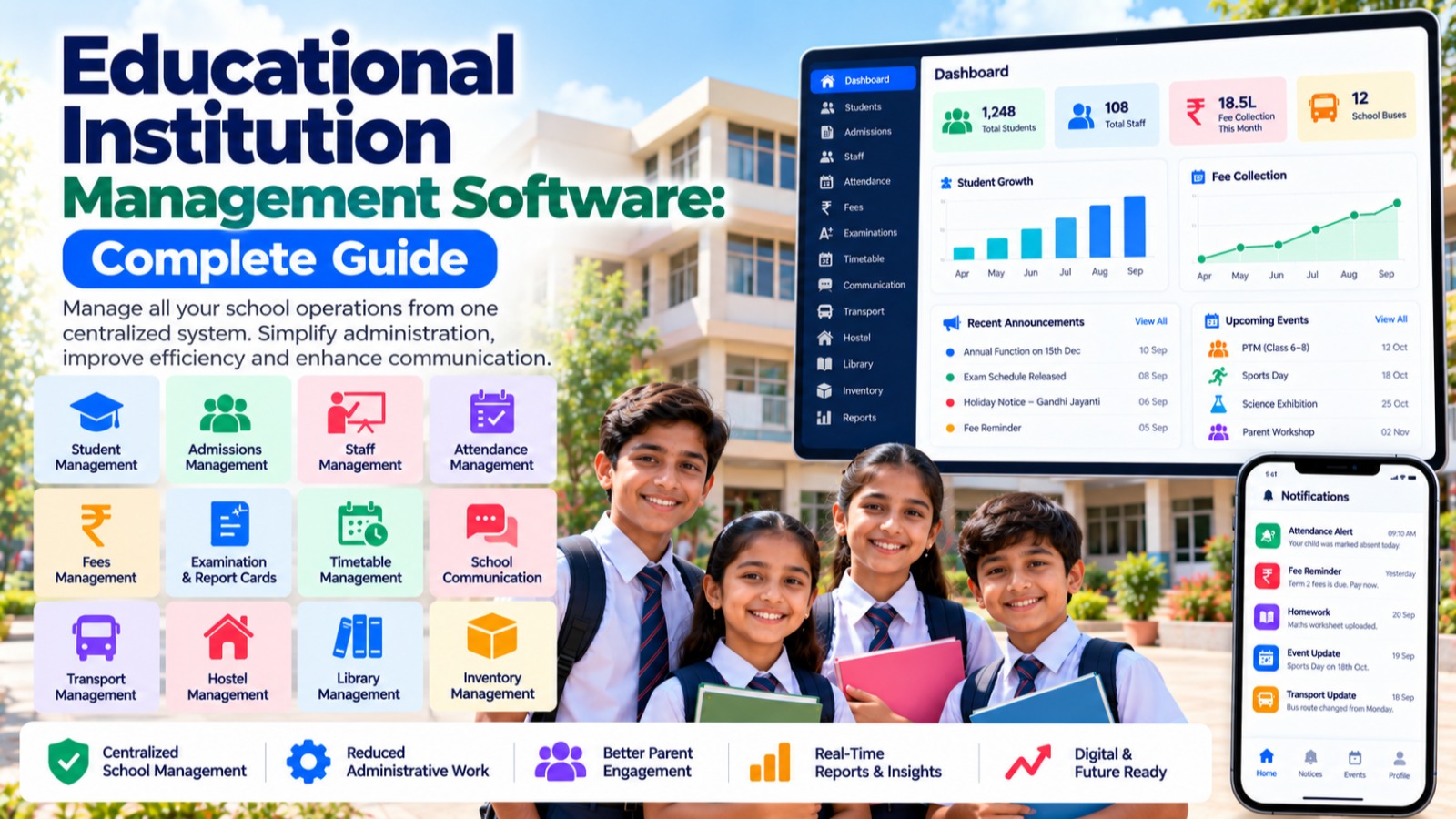

Managing an educational institution involves much more than teaching students. School owners, principals, administrators, teachers, accountants, and support staff have to coordinate admissions, students, staff, attendance, fees, examinations, timetables, communication, transport, hostels, libraries, inventory, events, and many other daily activities.
When these operations are managed using registers, spreadsheets, paper documents, and multiple disconnected applications, administrative work can become complicated and time-consuming.
Educational Institution Management Software provides a centralized digital solution for managing academic, administrative, financial, and operational activities from one platform.
A modern School ERP such as S2DENTSHIVE brings multiple school management functions together, helping educational institutions manage their day-to-day operations through one centralized system.
This complete guide explains what Educational Institution Management Software is, its key features, benefits, implementation process, and how S2DENTSHIVE can help schools simplify institution management.
What Is Educational Institution Management Software?
Educational Institution Management Software is a digital platform designed to help schools and educational institutions manage their academic, administrative, financial, and operational activities.
Instead of using separate systems for different departments, an institution can use one centralized platform to manage important information and workflows.
Depending on the software, an institution can manage:
- Student information
- Admissions
- Staff and teachers
- Attendance
- Fees
- Examinations
- Report cards
- Timetable
- Homework and assignments
- Communication
- Transport
- Hostel
- Library
- Inventory
- Events
- Expenses
- Reports and dashboards
- Online and live classes
The objective is to connect different areas of institution management and reduce repetitive administrative work.
Why Do Educational Institutions Need Management Software?
As an educational institution grows, the amount of information it needs to manage also increases.
A school may have:
- Hundreds or thousands of students
- Dozens or hundreds of teachers
- Multiple classes and sections
- Several departments
- Different fee structures
- Multiple school buses
- Hostels
- Libraries
- Laboratories
- Inventory
- Events and activities
- Different administrative teams
Managing all these operations through Excel files and paper records can make it difficult to maintain accurate and centralized information.
Educational Institution Management Software helps bring these operations together.
Common Problems With Manual Institution Management
Schools and educational institutions relying on manual processes may experience:
- Duplicate student records
- Scattered staff information
- Manual attendance calculations
- Difficult fee tracking
- Complex admission processes
- Timetable conflicts
- Slow report generation
- Communication delays
- Multiple spreadsheets
- Difficult document management
- Lack of centralized information
- Repeated data entry
- Difficulty managing multiple branches
A centralized management platform can help reduce many of these challenges.
Key Features of Educational Institution Management Software
A complete educational institution management system should cover both academic and administrative requirements.
1. Student Management
Student management is one of the core components of an educational institution management system.
Schools can maintain:
- Student profiles
- Admission numbers
- Class and section
- Parent/guardian information
- Contact details
- Academic information
- Documents
- Student status
- Transfer information
A centralized student profile can then be connected with other modules.
For example:
Student → Attendance → Fees → Exams → Report Card → Communication
2. Admission Management
Admissions are an important part of school administration.
Admission management software can help schools manage:
- Enquiries
- Prospective students
- Admission forms
- Follow-ups
- Document collection
- Interviews
- Entrance tests
- Admission status
- Student enrollment
Digital admission management can reduce paperwork and improve visibility into the admission process.
3. School Staff Management
Educational institutions need to manage teachers and non-teaching employees.
Staff management can include:
- Teacher profiles
- Employee records
- Departments
- Designations
- Roles
- Staff attendance
- Leave
- Teacher assignments
- Documents
- Permissions
When staff management is integrated with the School ERP, teachers can also be connected with subjects, classes, timetables, attendance, and academic responsibilities.
4. Attendance Management
Attendance is a daily requirement for educational institutions.
A digital attendance system can manage:
- Student attendance
- Staff attendance
- Daily attendance
- Absence
- Late attendance
- Half-day attendance
- Leave
- Attendance reports
Modern systems may also support different attendance methods, including camera-based or other digital attendance workflows depending on the institution's requirements.
5. Fee Management
Managing fees is one of the most important administrative responsibilities of a school.
Fee management software can help institutions manage:
- Fee structures
- Fee groups
- Fee types
- Student-wise fees
- Discounts
- Installments
- Payments
- Pending fees
- Receipts
- Payment links
- Fee reminders
- Collection reports
When fee management is connected with communication, schools can also streamline fee reminder workflows.
For example:
Pending Fee → Parent Reminder → Payment Link → Payment → Receipt
6. Examination Management
Educational institutions conduct examinations throughout the academic year.
Examination management can help schools manage:
- Examination schedules
- Subjects
- Marks
- Grades
- Results
- Report cards
- Performance
- Examination reports
Digital examination management reduces manual calculations and helps organize student academic records.
7. Report Card Management
Report cards provide parents and students with information about academic performance.
A digital system can help schools manage:
- Subject marks
- Grades
- Examination results
- Academic performance
- Student information
- Report card generation
When examination and student management are integrated, schools can generate student academic records more efficiently.
8. Timetable Management
Creating a school timetable manually can be complicated.
Timetable management software can help organize:
- Classes
- Sections
- Subjects
- Teachers
- Periods
- Classrooms
- Teacher schedules
It can also help administrators identify scheduling conflicts and make timetable changes more efficiently.
9. Homework and Assignment Management
Teachers can use digital academic management tools to manage:
- Homework
- Assignments
- Study materials
- Submission dates
- Student submissions
- Academic instructions
This provides students and parents with easier access to academic information.
10. School Communication
Communication is an important part of school administration.
Educational institution management software can support communication with:
- Parents
- Students
- Teachers
- Staff
Schools can communicate information about:
- Attendance
- Fees
- Examinations
- Homework
- Events
- Holidays
- Announcements
- Transport
- Hostel activities
Targeted communication can help ensure that relevant information reaches the appropriate users.
11. Transport Management
Schools operating transportation services need to manage:
- Vehicles
- Drivers
- Conductors
- Routes
- Stops
- Students
- Trips
- Transport assignments
- Transport fees
A centralized School ERP can connect transport information with student and parent records.
Modern transport management can also support digital or live location workflows depending on the school's requirements.
12. Hostel Management
Residential schools need dedicated hostel management capabilities.
A hostel management system can organize:
- Hostels
- Rooms
- Beds
- Student allocation
- Occupancy
- Vacant beds
- Hostel fees
- Hostel attendance
- Leave
- Hostel staff
- Reports
This makes it easier to manage residential students alongside their academic information.
13. Library Management
School libraries may contain hundreds or thousands of books.
Library management software can help manage:
- Books
- Categories
- Authors
- Publishers
- Book copies
- Members
- Issue records
- Return records
- Due dates
- Overdue books
- Fines
- Library reports
Integrating library management with student and staff information eliminates unnecessary duplicate records.
14. Inventory Management
Educational institutions have many physical assets and consumable items.
Inventory management can help schools manage:
- Inventory types
- Items
- Purchases
- Vendors
- Assets
- Stock
- Bookings
- Issue records
- Asset tags
A centralized inventory system provides better visibility into institutional resources.
15. Events and Activities Management
Schools organize many events during the academic year.
An institution management system can help manage:
- School events
- Competitions
- Celebrations
- Sports activities
- Cultural programs
- Academic activities
- Important dates
- Event announcements
Event information can also be connected with school communication.
16. Expense Management
Schools have various operational expenses.
Expense management can help administrators record:
- Expenses
- Categories
- Vendors
- Payments
- Transactions
- Expense reports
This provides better visibility into institutional spending.
17. Reports and Dashboards
School management software can provide dashboards that summarize important information.
A management dashboard may show:
- Student count
- Staff count
- Attendance
- Fee collection
- Pending fees
- Expenses
- Admissions
- Examination performance
- Transport information
- Hostel occupancy
This helps school owners and principals understand institution operations from a centralized view.
18. Role-Based Access
Not every employee needs access to every module.
Role-based permissions can allow institutions to provide appropriate access to:
- Super administrators
- Principals
- Teachers
- Accountants
- Receptionists
- Librarians
- Transport managers
- Hostel administrators
- Other staff
This can help protect sensitive information while keeping workflows organized.
19. Multi-Branch Management
School groups may operate multiple branches.
Each branch may have its own:
- Students
- Staff
- Classes
- Fees
- Transport
- Hostel
- Library
- Academic schedules
A centralized educational management system can help manage multiple branches while maintaining appropriate access and organization.
Benefits of Educational Institution Management Software
Implementing a centralized institution management system can provide several benefits.
1. Centralized Data
Important institutional information can be managed from one platform.
2. Reduced Manual Work
Digital workflows reduce repetitive administrative tasks.
3. Better Data Accuracy
Centralized records can reduce duplicate and inconsistent information.
4. Faster Administration
Staff can access information without searching through multiple registers and files.
5. Better Parent Communication
Parents can receive timely information about students and school activities.
6. Improved Financial Management
Fee collection, pending fees, receipts, and expenses can be organized digitally.
7. Better Academic Management
Attendance, examinations, report cards, timetable, and homework can be connected.
8. Better Decision-Making
Dashboards and reports give school management better visibility into operations.
9. Improved Collaboration
Teachers, administrators, parents, and students can work through connected digital workflows.
10. Reduced Dependence on Multiple Applications
A centralized School ERP can bring multiple school functions together.
Educational Institution Management Software vs Excel
Excel is useful for basic data storage, but it becomes difficult to manage an entire educational institution through spreadsheets.
| Feature | Excel/Manual | Institution Management Software |
|---|---|---|
| Student management | Yes | Yes |
| Staff management | Yes | Yes |
| Admissions | Manual | Digital |
| Attendance | Manual | Integrated |
| Fees | Manual | Integrated |
| Examinations | Manual | Digital |
| Report cards | Manual | Digital |
| Timetable | Manual | Structured |
| Communication | Separate | Integrated |
| Transport | Separate | Integrated |
| Hostel | Separate | Integrated |
| Library | Separate | Integrated |
| Inventory | Manual | Digital |
| Reports | Manual | Automated/structured |
| Role-based access | Limited | Yes |
| Multi-branch management | Difficult | Easier |
| Centralized database | No | Yes |
The biggest advantage of dedicated software is not simply replacing Excel. It is connecting different school operations into one system.
How Educational Institution Management Software Works
A centralized system can connect different departments and workflows.
For example:
Admission
Enquiry → Application → Documents → Admission → Student Profile
Attendance
Student → Class → Attendance → Attendance Report → Parent Notification
Fees
Fee Structure → Student Fee → Collection → Receipt → Reminder
Examination
Exam → Subjects → Marks → Results → Report Card
Timetable
Teacher → Subject → Class → Period → Timetable
Transport
Student → Route → Stop → Vehicle → Transport Management
Hostel
Student → Hostel → Room → Bed → Occupancy
These connected workflows reduce duplicate data entry and help administrators manage information more efficiently.
S2DENTSHIVE Provides Educational Institution Management Software
S2DENTSHIVE provides Educational Institution Management Software through its centralized School ERP platform.
The platform brings multiple school management functions together so that educational institutions can manage their academic, administrative, financial, and operational requirements from one system.
S2DENTSHIVE provides a centralized environment for managing areas such as:
- Student Management
- Staff Management
- Admissions
- Attendance
- Camera Attendance
- Fees Management
- Fee Reminders
- Online Payment Links
- Examination Management
- Report Cards
- Timetable Management
- Homework and Assignments
- School Communication
- Transport Management
- Hostel Management
- Library Management
- Inventory Management
- Events and Activities
- Expense Management
- Reports and Dashboards
- Live Classes
This integrated approach allows schools to manage multiple departments without depending on a separate application for every operation.
Why Choose S2DENTSHIVE for Educational Institution Management?
For school owners and principals, managing multiple applications can create unnecessary complexity.
For example, an institution may otherwise have:
- One application for student management
- Another for fees
- Another for attendance
- Another for communication
- Another for transport
- Another for hostel
- Another for library
- Another for examinations
S2DENTSHIVE follows a centralized School ERP approach where these areas can be managed within one broader system.
The advantage is that information can be connected across modules.
For example:
Student Profile → Attendance → Fees → Examination → Report Card → Communication
Or:
Teacher → Subject → Timetable → Attendance → Academic Management
Or:
Student → Transport → Route → Parent Communication
This connected approach can reduce duplicate data entry and provide administrators with a more complete view of school operations.
How S2DENTSHIVE Can Help School Owners and Principals
School owners and principals need visibility across different areas of the institution.
A centralized School ERP can help management monitor:
Students
- Total students
- Class-wise students
- Admissions
- Student information
Staff
- Teachers
- Employees
- Staff roles
- Staff attendance
Finance
- Fee collection
- Pending fees
- Expenses
- Transactions
Academics
- Attendance
- Examinations
- Report cards
- Timetable
- Homework
Operations
- Transport
- Hostel
- Library
- Inventory
- Events
Communication
- Parent notifications
- Student communication
- Staff announcements
- Fee reminders
- Attendance alerts
This gives management a centralized overview of the institution.
How to Implement Educational Institution Management Software
Successful implementation requires proper planning.
Step 1: Identify School Requirements
List the institution's current processes and challenges.
Step 2: Select Required Modules
Identify which modules are needed, such as:
- Students
- Staff
- Admissions
- Attendance
- Fees
- Exams
- Timetable
- Communication
- Transport
- Hostel
- Library
- Inventory
Step 3: Prepare Existing Data
Organize student, staff, fee, class, subject, and other data for migration.
Step 4: Configure the System
Set up:
- Academic years
- Classes
- Sections
- Subjects
- Users
- Roles
- Fee structures
- Departments
Step 5: Train Staff
Train administrators, teachers, accountants, and other users according to their responsibilities.
Step 6: Start With Core Modules
Schools can begin with important modules such as student management, attendance, fees, and staff management.
Step 7: Expand Gradually
Additional modules such as transport, hostel, library, inventory, and communication can be integrated into the workflow.
Step 8: Monitor and Improve
Management should regularly review reports and user feedback to improve digital processes.
Who Can Benefit From Educational Institution Management Software?
Educational institution management software can benefit:
- Private schools
- CBSE schools
- ICSE schools
- State board schools
- International schools
- Boarding schools
- K-12 schools
- School groups
- Multi-branch institutions
- Educational organizations
It is particularly useful for institutions that manage a large number of students, staff, academic activities, and administrative processes.
What Should Schools Look for in Institution Management Software?
Before selecting a platform, school owners and administrators should consider:
1. Complete School Management
The system should cover both academic and administrative requirements.
2. Centralized Student Database
Student information should be available across relevant modules.
3. Staff Management
Teachers and employees should be managed digitally.
4. Attendance
The system should support student and staff attendance.
5. Fee Management
It should support fee structures, collection, reminders, and reports.
6. Examination Management
Schools should be able to manage exams, marks, results, and report cards.
7. Communication
The system should support parent, student, teacher, and staff communication.
8. Operational Modules
Transport, hostel, library, inventory, and events should be available where required.
9. Reports and Dashboards
Management should have access to useful institutional reports.
10. Security and Access Control
Different users should receive appropriate permissions.
11. Scalability
The platform should be able to support growing student numbers and additional branches.
12. Centralized Architecture
Schools should ideally be able to manage multiple operations without depending on numerous disconnected applications.
Future of Educational Institution Management Software
Educational institutions are increasingly moving toward centralized digital management.
Future education management systems are likely to focus on:
- AI-assisted administration
- Automated workflows
- Predictive analytics
- Digital admissions
- Smart attendance
- Automated fee reminders
- Personalized parent communication
- Mobile-first school management
- Advanced dashboards
- Digital learning integration
- Automated reporting
- Integrated transport and hostel management
- AI-assisted academic planning
The goal is to make educational administration more efficient while giving teachers, parents, students, and management better access to relevant information.
Conclusion
Managing an educational institution involves hundreds of daily activities across academics, administration, finance, communication, and operations.
Using separate spreadsheets and applications for each function can make school management complicated and increase repetitive work.
Educational Institution Management Software provides a centralized way to manage students, staff, admissions, attendance, fees, examinations, timetable, communication, transport, hostel, library, inventory, expenses, events, and other school operations.
S2DENTSHIVE provides Educational Institution Management Software through its centralized School ERP, helping schools manage these functions within one connected platform.
For school owners and principals, the objective is not simply to digitize individual processes. It is to create a centralized school management environment where information can move between departments and authorized users can access the information they need.
With S2DENTSHIVE, schools can bring multiple operations together and reduce their dependence on separate applications for student management, fees, attendance, examinations, communication, transport, hostel, library, inventory, and other school functions.
Comments (0)
Share your thoughts or ask a question about this article.
Leave a Comment