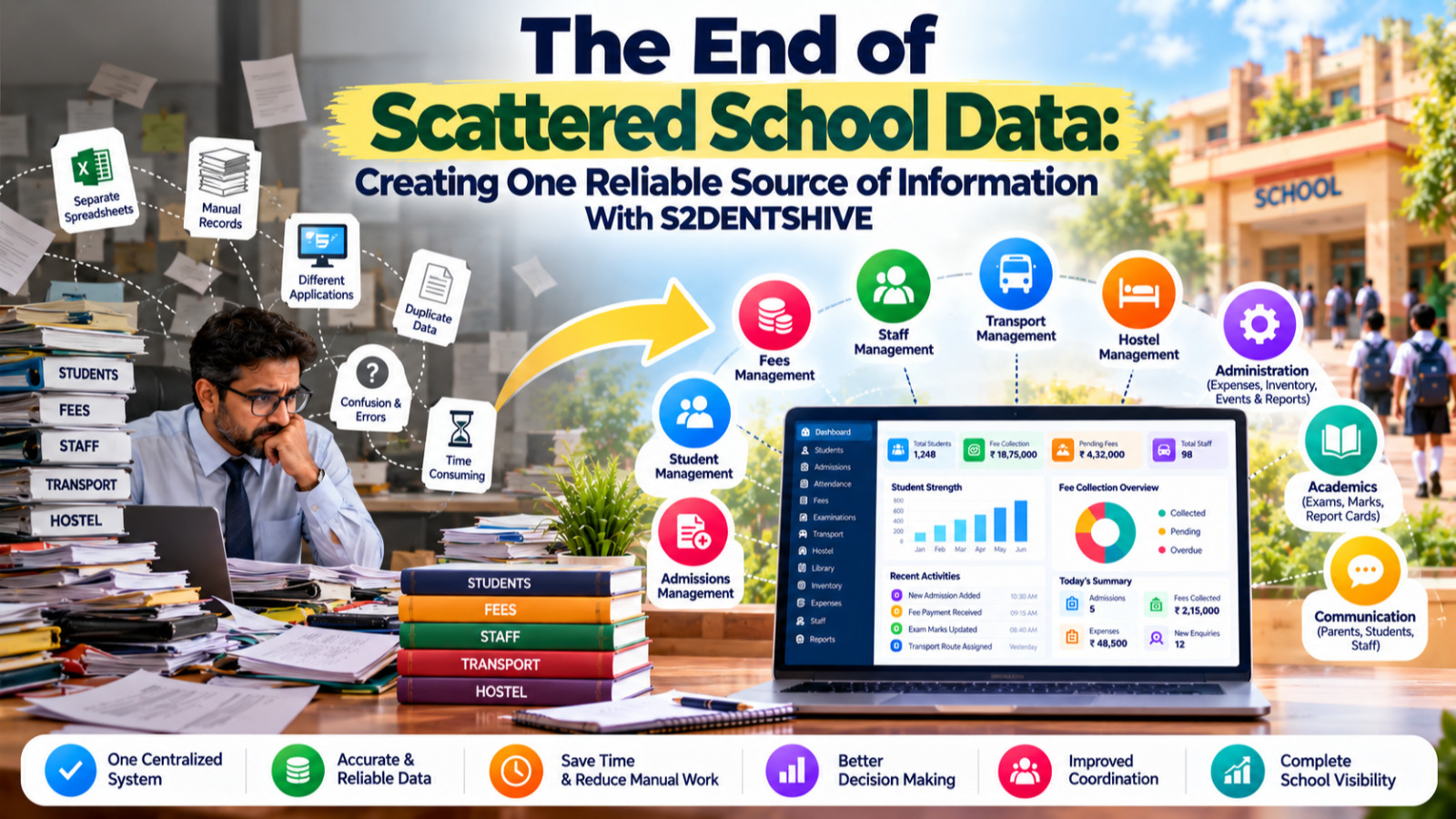

A school generates information every minute.
A student gets admitted.
A teacher records attendance.
A parent pays a fee.
A vehicle completes a trip.
A student is assigned to a hostel room.
An examination mark is entered.
A staff member checks in.
An expense is recorded.
A notice is published.
Every one of these activities creates data.
The real challenge for many schools is not generating this information.
The challenge is keeping it organized, connected and reliable.
When student information is stored in one application, fee information in another, attendance in spreadsheets, transport records in registers and hostel information somewhere else, the school may technically have all the required data—but it does not have one reliable source of information.
This creates confusion, repeated work and delays in decision-making.
S2DENTSHIVE approaches school management differently.
Instead of allowing important information to remain scattered across multiple systems, S2DENTSHIVE brings major school operations together on one centralized platform.
The goal is simple:
One School. One Connected Database. One Reliable Source of Information.
What Is Scattered School Data?
Scattered school data means information about the same institution exists across different locations, systems, files or departments without being properly connected.
For example, consider a single student.
The admissions department may have:
-
Student name
-
Parent details
-
Contact information
-
Admission date
The accounts department may separately have:
-
Fee structure
-
Assigned fees
-
Payments
-
Pending amount
The class teacher may have:
-
Attendance
-
Academic information
-
Class details
The transport department may have:
-
Route
-
Vehicle
-
Boarding point
The hostel department may have:
-
Hostel
-
Room
-
Seat allocation
The examination department may have:
-
Marks
-
Examination records
-
Report card
All of this information belongs to the same student.
But if it exists in separate systems, the school does not really have a single student record.
It has several disconnected versions of the same information.
Why Scattered Data Becomes a Serious School Management Problem
Scattered data may appear manageable when the school is small.
As the number of students, staff, vehicles, departments and activities increases, however, the problem becomes much larger.
Administrators may spend time asking:
-
Which record is correct?
-
Has this student's fee been paid?
-
Which class is this student currently assigned to?
-
Is this student using school transport?
-
Which hostel room has been allocated?
-
What is the student's attendance?
-
Which staff member is responsible?
-
Where is the latest report?
-
Has this information been updated?
Instead of managing the school, employees end up managing information.
That is one of the biggest disadvantages of disconnected school systems.
The Hidden Cost of Multiple Data Sources
Scattered data creates costs that are not always immediately visible.
1. Repeated Data Entry
The same student information may be entered several times.
This wastes administrative time and increases the possibility of mistakes.
2. Duplicate Records
The same person may accidentally have multiple records in different departments.
This can make reporting difficult.
3. Outdated Information
One spreadsheet may be updated while another remains unchanged.
Now two departments may have different information about the same student.
4. Difficult Reporting
Management reports may require information from several departments.
Employees then have to collect, combine and verify data manually.
5. Slower Decisions
School owners may not get the information they need immediately.
Decisions are delayed because data first needs to be collected.
6. Increased Dependency on Individuals
When information exists in personal spreadsheets or registers, the school may become dependent on specific employees who know where everything is stored.
A centralized system reduces this dependency.
What Does a “Single Source of Truth” Mean for a School?
A single source of truth means there is a central, trusted system where important school information is maintained.
Instead of asking:
“Which spreadsheet has the latest student data?”
the administration should be able to ask:
“What does the school management system show?”
This does not mean every employee should have access to every piece of information.
Access can remain controlled according to responsibilities and permissions.
The important point is that authorized users work with information from the same central system.
S2DENTSHIVE is designed around this centralized approach.
S2DENTSHIVE as the Central Information Hub
S2DENTSHIVE connects multiple areas of school management within one platform.
These can include:
-
Student Management
-
Admissions
-
Staff Management
-
Attendance
-
Fees
-
Fee Reminders
-
Payment Links
-
Examinations
-
Marks
-
Report Cards
-
Timetable
-
Transport
-
Hostel
-
Library
-
Inventory
-
Assets
-
Expenses
-
Events
-
Communication
-
Reports
-
Live Classes
Instead of treating each department as an independent operation, S2DENTSHIVE creates a connected digital environment.
This allows information to become more useful because it is connected to the rest of the school's operations.
1. One Student Record Instead of Multiple Student Records
The student is at the center of school operations.
A student interacts with almost every major department.
Therefore, the student profile should not exist as isolated information.
With a centralized platform, the student's digital record can connect relevant information such as:
Admission → Student Profile → Class → Attendance → Fees → Transport → Hostel → Exams → Marks → Report Card
This creates a much more complete view of the student.
Administrators do not need to reconstruct the student's history by collecting information from multiple departments.
2. Admissions Become the Starting Point of a Digital Record
The student journey begins before admission.
A parent makes an enquiry.
The school receives an application.
The admission team processes the information.
The student is admitted.
After admission, the student becomes part of the school's academic and administrative system.
When admissions are disconnected from the rest of school management, the same information may have to be entered again.
A centralized system can help transform admission information into the foundation of the student's ongoing school record.
This creates a connected journey:
Enquiry → Application → Admission → Student → Class → Attendance → Fees → Academics
The school can maintain continuity from the first interaction onward.
3. Fees Become Connected to the Student
Fee management is one of the areas where scattered information can create significant confusion.
A school may maintain:
-
Fee structures
-
Student assignments
-
Discounts
-
Payments
-
Pending amounts
-
Receipts
-
Reminders
-
Payment links
If these records exist separately from the student profile, the accounts department has to constantly match information.
With S2DENTSHIVE, fee information can remain connected with student records.
This makes it easier for authorized users to understand:
-
What fees are assigned?
-
What has been paid?
-
What remains pending?
-
What reminders are required?
-
What is the student's payment history?
The result is a more organized fee management process.
4. Attendance Becomes More Meaningful When It Is Connected
Attendance is not just a daily number.
It becomes much more useful when connected with the student's broader information.
For example, administrators may need to understand attendance alongside:
-
Class
-
Section
-
Student profile
-
Academic performance
-
Examination information
S2DENTSHIVE provides digital attendance management within the broader school management ecosystem, including support for camera-based attendance workflows where applicable.
This reduces the need to maintain attendance as a completely isolated system.
5. Staff Data Should Not Live in Separate Files
Schools also generate significant employee information.
Staff records may include:
-
Employee details
-
Role
-
Department
-
Employment information
-
Attendance
-
Responsibilities
-
School-specific assignments
When this information is maintained through separate files, administrators may struggle to get an updated picture of their workforce.
S2DENTSHIVE helps bring staff information and attendance into a centralized environment.
This allows management to move away from scattered employee records toward a structured digital staff database.
6. Transport Information Can Be Connected With Students
Transport is another department where disconnected data can create problems.
The transport team needs to know:
-
Which students use transport?
-
Which route are they assigned to?
-
Which boarding point do they use?
-
Which vehicle is assigned?
-
Who is the driver?
-
Who is the conductor?
When student and transport records are disconnected, administrators may need to manually match information.
With a connected system, the relationship can become:
Student → Boarding Point → Route → Vehicle → Driver/Conductor
This makes transport information easier to organize and manage.
7. Hostel Records Become Part of the Student Journey
For schools with hostel facilities, student accommodation information is also important.
The school may need to manage:
-
Hostel buildings
-
Rooms
-
Seats
-
Occupancy
-
Vacancies
-
Student allocation
If hostel records exist in separate registers, management may not have an immediate view of hostel occupancy.
With S2DENTSHIVE, hostel information can be maintained as part of the school's centralized digital ecosystem.
This makes it easier to understand both:
Hostel Capacity
and
Student Allocation
from an organized digital environment.
8. Examination and Academic Data Should Stay Connected
Academic information is one of the most important categories of school data.
Schools manage:
-
Subjects
-
Timetables
-
Examinations
-
Marks
-
Report cards
-
Academic records
If examination data exists separately from student information, administrators may have difficulty getting a complete view of academic progress.
A centralized system can connect the student's academic information with the broader student record.
This helps create a continuous student profile rather than a collection of isolated academic documents.
9. Expenses and Inventory Add Another Layer of Visibility
School data is not limited to students and teachers.
The administration also manages money and physical resources.
For example:
Expenses
-
Maintenance
-
Utilities
-
Transport
-
Events
-
Administrative costs
-
Operational purchases
Inventory
-
Furniture
-
Equipment
-
Books
-
Sports materials
-
Computers
-
Office supplies
-
Other assets
Keeping these records digitally and centrally can improve administrative visibility.
S2DENTSHIVE helps schools bring expenses, inventory and assets into the broader school management environment.
10. Reports Become More Reliable When Data Is Centralized
One of the biggest benefits of centralized data is reporting.
Imagine that the school owner wants to understand the institution's current position.
They may need:
-
Total students
-
Fee collection
-
Pending fees
-
Staff strength
-
Attendance
-
Transport usage
-
Hostel occupancy
-
Expenses
-
Academic results
If information exists in multiple systems, preparing this report can take hours.
When information is maintained within a centralized platform, reports can be generated from a more consistent data environment.
This can help management move from:
Manual Report Collection → Centralized Reporting
11. School Owners Get a More Reliable Management View
For a school owner, the biggest advantage of centralized data is visibility.
Instead of relying entirely on verbal updates from different departments, management can access information through the school's digital system.
This can answer important questions such as:
Student Side
How many students are currently enrolled?
Financial Side
How much has been collected and how much remains pending?
Staff Side
How many employees are active and what is their attendance?
Transport Side
How many students are using transport and how are routes organized?
Hostel Side
How many seats are occupied and how many remain available?
Academic Side
What are the examination and academic results?
Operational Side
What expenses and inventory activities are taking place?
This creates a much stronger foundation for decision-making.
12. One Reliable Record Reduces Administrative Confusion
Imagine two departments have different phone numbers for the same parent.
Which one should be used?
Or one department says a student is using transport while another says the student is not.
Which information is correct?
Or the accounts department shows a pending fee while another spreadsheet shows the fee as paid.
These situations are common when information is maintained independently.
A centralized platform creates a common reference point.
Authorized users can work from the same core information.
This can significantly reduce administrative confusion.
13. Centralization Does Not Mean Everyone Sees Everything
A common concern with centralized systems is data access.
A centralized database does not mean every employee should have access to every record.
Different users can have different responsibilities and permissions.
For example:
-
Accounts staff can access fee-related information.
-
Teachers can access relevant academic and attendance information.
-
Transport staff can access transport-related information.
-
Hostel staff can access hostel-related information.
-
Administrators can access broader operational data.
-
School owners can receive management-level visibility.
This provides the advantages of centralization while maintaining controlled access.
14. From “Where Is the Data?” to “What Does the Data Tell Us?”
This is perhaps the biggest transformation created by centralized school management.
When information is scattered, employees spend time finding it.
When information is centralized, they can spend more time understanding it.
The question changes from:
“Where is the latest report?”
to:
“What is the report telling us?”
The question changes from:
“Which spreadsheet contains this student's information?”
to:
“What does the student's complete record show?”
That is the difference between data storage and data-driven management.
15. Centralized Data Can Reduce Repetitive Work
Administrative teams often spend a significant amount of time repeating the same tasks.
Copying student names.
Updating spreadsheets.
Matching payment records.
Preparing lists.
Creating department-wise reports.
Searching through registers.
Cross-checking information.
A connected school ERP can reduce much of this repetitive work by allowing information to be entered and maintained within a centralized environment.
This does not eliminate the need for administrative oversight.
Instead, it allows employees to spend more time on meaningful work.
16. Better Data Means Better Decisions
Technology is valuable only when it helps management make better decisions.
A centralized system can help school owners identify patterns.
For example:
-
Increasing pending fees
-
Attendance concerns
-
Transport demand
-
Hostel occupancy
-
Staff availability
-
Expense trends
-
Student performance
-
Admission trends
Instead of making decisions based only on assumptions or delayed reports, management can use organized information.
This creates a shift toward:
Data → Insight → Decision → Action
17. Why One Centralized Platform Is Better Than Many Disconnected Applications
Using multiple applications may appear to provide more features.
But more applications can also mean:
-
More logins
-
More subscriptions
-
More data entry
-
More integrations
-
More training
-
More chances for duplication
-
More places where information can become outdated
The objective should not be to use the maximum number of applications.
The objective should be to create the most efficient management environment.
S2DENTSHIVE brings multiple school functions into one centralized platform so schools can manage more operations without creating unnecessary data silos.
18. S2DENTSHIVE Creates a Connected Digital School
S2DENTSHIVE is designed to connect the major operational areas of a school.
These include:
-
Admissions
-
Students
-
Staff
-
Attendance
-
Fees
-
Examinations
-
Marks
-
Report Cards
-
Timetable
-
Transport
-
Hostel
-
Library
-
Inventory
-
Assets
-
Expenses
-
Events
-
Communication
-
Reports
-
Live Classes
The real value is not simply having these modules.
The value is that they can operate as parts of the same school management ecosystem.
That is what transforms individual modules into a connected platform.
The Future Is Not More Data. It Is Better-Connected Data.
Schools already have enormous amounts of information.
The challenge is rarely the absence of data.
The challenge is fragmented data.
Modern school management should focus on making information:
Centralized
Connected
Accessible
Organized
Reliable
Actionable
This is where a modern School ERP can make a major difference.
Why S2DENTSHIVE Can Become the School's Single Source of Information
S2DENTSHIVE brings together the information generated across different departments and places it within one centralized school management environment.
For school owners, this means greater visibility.
For administrators, it means less searching.
For staff, it can mean fewer repetitive tasks.
For departments, it means better coordination.
For schools, it means a more organized digital infrastructure.
The goal is not simply to replace paper.
It is to eliminate the data silos that make school management unnecessarily complicated.
Conclusion: The End of Scattered School Data
A school cannot be truly digital if its information remains scattered.
Digital transformation is not about replacing one register with one spreadsheet.
It is about creating a connected system where important information can be maintained, accessed and used across the institution.
With S2DENTSHIVE, schools can bring students, admissions, fees, staff, attendance, academics, transport, hostel, inventory, expenses and administration together within one centralized platform.
The result is a simpler and more connected approach to school management.
Instead of asking:
“Where is the information?”
School management can focus on:
“What can we do with the information?”
That is the real shift from traditional school administration to modern digital management.
S2DENTSHIVE — One Centralized Platform. One Reliable Source of Information. One Smarter Way to Manage Your School.
Comments (0)
Share your thoughts or ask a question about this article.
Leave a Comment