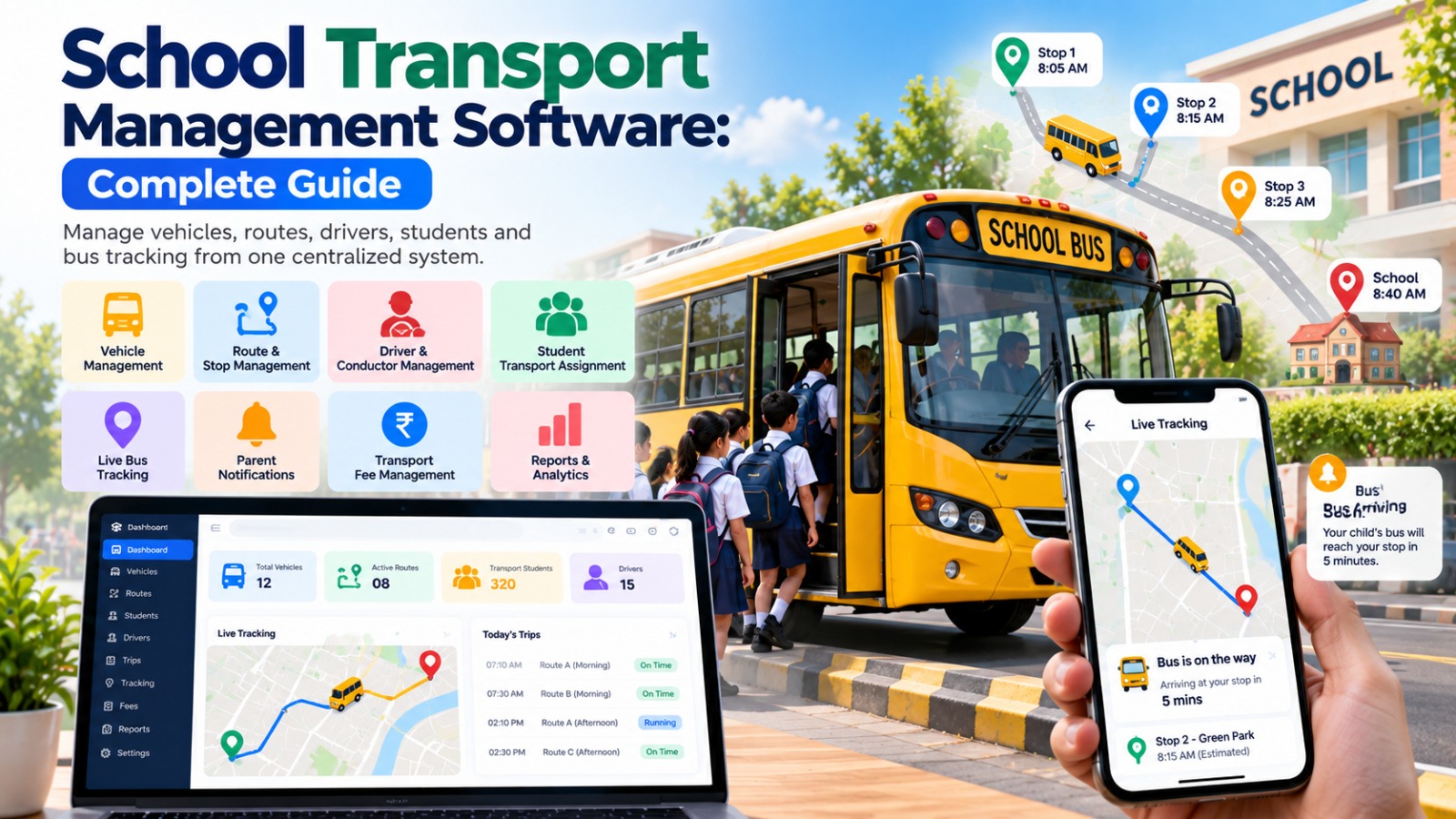

School transportation is an important part of daily school operations.
For schools that provide bus transportation, managing vehicles, drivers, conductors, routes, stops, students, trips, and parent communication can become a complex administrative responsibility.
Traditionally, many schools manage transport information through registers, spreadsheets, phone calls, WhatsApp groups, and separate GPS or tracking applications.
As the number of buses and students increases, managing these activities through disconnected systems can become difficult.
This is where School Transport Management Software can help.
A modern school transport management system brings important transportation activities into a centralized digital platform. It can help schools organize vehicle information, routes, drivers, student transport assignments, trip information, and communication with parents.
As part of a complete School ERP, transport management can also connect transportation information with student records, fees, attendance, staff management, and other school operations.
S2DENTSHIVE includes Transport Management as one of its School ERP modules, alongside student management, attendance, timetable, fees, examinations, staff management, inventory, library, and other functions.
What Is School Transport Management Software?
School Transport Management Software is a digital system designed to help educational institutions manage their transportation operations.
A school transport system can help administrators manage information related to:
-
School buses
-
Vehicles
-
Drivers
-
Conductors
-
Routes
-
Bus stops
-
Students
-
Transport assignments
-
Trips
-
Pickup and drop-off
-
Transport fees
-
Vehicle schedules
-
Parent communication
-
Bus tracking
-
Transport reports
The exact features available depend on the School ERP and the school's transportation setup.
The primary objective is to replace disconnected transport records with a centralized transportation management system.
Why Do Schools Need Transport Management Software?
Managing school transportation involves coordination between multiple people.
For example:
School Management
needs visibility into vehicles, routes, students, and operations.
Transport Administrators
need to manage routes, stops, schedules, drivers, and assignments.
Drivers and Conductors
need information about their assigned vehicles, routes, trips, and students.
Parents
want information about their child's transportation and, where available, the current location of the school bus.
When these activities are managed using separate applications and manual records, communication can become difficult.
A centralized transport management system helps bring these processes together.
Common Challenges in School Transport Management
Schools may face several challenges when transportation is managed manually.
1. Managing Multiple Vehicles
Schools may operate multiple buses or other vehicles, each with different routes and schedules.
Maintaining vehicle information in spreadsheets can become difficult as the fleet grows.
2. Managing Drivers and Conductors
Transport teams need accurate information about assigned drivers and conductors.
Changes in assignments also need to be tracked properly.
3. Route Management
Each vehicle may serve multiple stops and student pickup locations.
Managing these routes manually can create unnecessary administrative work.
4. Student Transport Assignment
Schools need to know which students are using which route, vehicle, and stop.
This information should ideally be connected with the student's main school record.
5. Parent Communication
Parents may need updates about:
-
Bus location
-
Delays
-
Route changes
-
Pickup information
-
Drop-off information
-
Other transportation updates
Managing these communications manually can be time-consuming.
6. Transport Fee Management
Students using school transportation may have additional transportation fees.
When transport and fee management are disconnected, administrators may need to maintain separate records.
Key Features of School Transport Management Software
1. Vehicle Management
A School Transport Management System should provide a centralized place to maintain vehicle information.
Depending on the school's requirements, records may include:
-
Vehicle number
-
Vehicle type
-
Registration details
-
Capacity
-
Status
-
Assigned route
-
Driver
-
Conductor
-
Other vehicle information
This makes it easier for administrators to monitor their school transportation fleet.
2. Driver Management
Drivers are a critical part of school transportation.
A transport management system can connect driver information with assigned vehicles and routes.
Schools can maintain information such as:
-
Driver profile
-
Contact details
-
Assigned vehicle
-
Assigned route
-
Trip assignments
-
Employment information
When driver information is connected to transport operations, administrators can quickly identify who is responsible for a particular vehicle or trip.
3. Conductor Management
Depending on the school's transport structure, buses may also have conductors or attendants.
The system can maintain conductor information and associate them with relevant vehicles or trips.
This provides clearer responsibility for each transport operation.
4. Route Management
Route management is one of the most important components of school transportation.
A route may contain multiple stops.
For example:
Route A
School → Stop 1 → Stop 2 → Stop 3 → Stop 4 → Stop 5
A digital transport system can organize:
-
Route name
-
Route number
-
Stops
-
Stop sequence
-
Assigned vehicle
-
Driver
-
Conductor
-
Students assigned to the route
This makes route administration easier.
5. Bus Stop Management
Schools can maintain a centralized list of bus stops.
Each stop can be associated with:
-
Route
-
Pickup time
-
Drop-off time
-
Students
-
Vehicle
This helps transport administrators understand exactly which students are assigned to each location.
6. Student Transport Assignment
Not every student uses school transportation.
The system should therefore allow schools to assign transport services only to applicable students.
Student transport information may include:
-
Transport required
-
Route
-
Vehicle
-
Pickup stop
-
Drop-off stop
-
Transport fee
-
Academic year
-
Transport status
Because S2DENTSHIVE is designed as an integrated School ERP, transport management can be associated with the broader student management ecosystem.
7. Bus Trip Management
Schools may operate different trips during the day.
For example:
-
Morning pickup
-
Afternoon drop-off
-
Special trip
-
Activity trip
-
Examination trip
A transport management system can help administrators organize these trips and associate them with the relevant vehicle and transport team.
This provides a structured record of transport operations.
8. School Bus Tracking
Real-time bus tracking can provide parents and school administrators with greater visibility into the transportation journey.
S2DENTSHIVE's published privacy information describes a transport tracking feature that uses location permissions to provide parents with real-time updates on their child's school bus location. It also describes notifications related to delays or unexpected route changes.
This can help parents check the bus's current location through the application instead of repeatedly calling the school transport office.
9. Real-Time Location Updates
Where live tracking is enabled, location information can be used to show the current position of the school bus.
This can help answer practical questions such as:
-
Where is the bus?
-
Has the bus started its route?
-
Is the bus approaching the pickup point?
-
Has the bus reached the school?
-
Is there a delay?
S2DENTSHIVE states that its transport feature uses location permissions for transport tracking and enables parents to monitor the school bus's current position.
10. Parent Notifications
Transport communication is particularly important because parents need timely information about their child's journey.
Depending on the configured system, notifications can be used for:
-
Bus location
-
Delays
-
Route changes
-
Trip updates
-
Pickup information
-
Other transport-related events
S2DENTSHIVE's transport documentation specifically describes alerts or notifications for delays and unexpected route changes.
11. Transport Fee Management
Transportation often involves additional fees.
For example, a school may charge different amounts depending on:
-
Route
-
Distance
-
Pickup zone
-
Student category
-
Academic year
When transport management is integrated with the school's fee module, applicable transport charges can be managed along with the student's other fees.
S2DENTSHIVE supports online and offline fee payment as part of its broader ERP functionality.
12. Transport and Student Records
One of the major advantages of an integrated School ERP is that transportation does not need to exist as a completely separate database.
The transport record can be connected with:
-
Student profile
-
Parent information
-
Class
-
Section
-
Academic year
-
Fee information
This reduces duplicate data entry and makes student transportation information easier to access.
13. Transport Dashboard
A centralized transport dashboard can provide school management with a quick overview of transportation operations.
Depending on the system, a dashboard can include:
-
Total vehicles
-
Active routes
-
Assigned students
-
Drivers
-
Conductors
-
Active trips
-
Transport fees
-
Vehicle status
-
Live transport information
This allows administrators to monitor transportation without checking multiple spreadsheets.
14. Transport Reports
Reports help school management understand how transportation is being utilized.
Useful reports can include:
Vehicle Report
Shows registered school vehicles and their current status.
Route Report
Shows routes and their associated stops.
Student Transport Report
Shows students assigned to transportation.
Driver Report
Shows driver assignments.
Stop-Wise Student Report
Shows students assigned to each pickup or drop-off point.
Transport Fee Report
Shows applicable and collected transport fees.
Trip Report
Shows scheduled or recorded transport trips.
Reports can make routine transport administration easier and reduce manual report preparation.
15. Transport Management for Multiple School Branches
Schools operating multiple campuses may have more complex transport requirements.
Different branches may have:
-
Separate vehicles
-
Different routes
-
Different drivers
-
Different stops
-
Different student populations
S2DENTSHIVE supports multi-branch management as part of its School ERP capabilities.
An integrated approach can help management organize transportation information according to the relevant branch.
16. Better Parent Experience
Parents often have one major concern regarding school transportation:
"Where is my child's bus?"
A transport management system can provide parents with relevant information through the school application.
S2DENTSHIVE describes its transport tracking functionality as allowing parents to monitor the school bus's location and stay informed about the child's commute.
This can reduce the need for repeated phone calls to the transport office.
17. Reduces Manual Transport Administration
Without dedicated software, transport administrators may have to maintain several files:
-
Vehicle list
-
Driver list
-
Route list
-
Student list
-
Stop list
-
Fee list
-
Trip records
A centralized transport module can bring these records together.
This can reduce repetitive data entry and make it easier to update information when:
-
A student changes routes
-
A vehicle changes
-
A driver changes
-
A stop is added
-
A route is modified
-
A student stops using transportation
18. Transport Management and School Safety
School transportation involves children, drivers, vehicles, and multiple pickup and drop-off locations.
Digital transport records can help schools maintain better operational visibility.
For example, administrators can know:
-
Which student is assigned to which route
-
Which vehicle is assigned
-
Which driver is responsible
-
Which stop the student uses
-
Whether a trip is active
Where live tracking is enabled, parents can also receive information about the bus journey.
Technology should complement the school's established transport safety procedures rather than replace them.
19. Transport Management and Communication
Transportation frequently requires quick communication.
For example:
Vehicle Delay
The bus is delayed because of traffic.
↓
Transport Administrator
Updates the relevant information.
↓
Parent
Receives an applicable notification.
This type of communication can reduce uncertainty and unnecessary phone calls.
20. Transport Management as Part of a Complete School ERP
A major advantage of S2DENTSHIVE is that transport is not presented as an isolated application.
S2DENTSHIVE positions itself as a comprehensive School Management ERP covering administrative, academic, and operational processes. Its published feature list includes transport management alongside student management, attendance, timetable, examinations, fee payment, library, inventory, staff payroll, leave management, communication, and other modules.
This creates a connected workflow.
For example:
Admission
↓
Student Management
↓
Transport Assignment
↓
Route & Stop
↓
Transport Fee
↓
Bus Tracking
↓
Parent Communication
This type of integration reduces the need to maintain separate records for every department.
School Transport Software vs. Manual Management
| Manual Transport Management | School Transport Management Software |
|---|---|
| Excel-based vehicle records | Centralized vehicle management |
| Paper route lists | Digital routes and stops |
| Manual student assignments | Student-wise transport assignment |
| Phone-based updates | Digital communication |
| Separate tracking application | Integrated transport functionality |
| Manual fee records | Connected transport fee management |
| Manual reports | Automated reports |
| Difficult historical tracking | Centralized records |
| Limited management visibility | Transport dashboard |
| Multiple disconnected tools | Integrated School ERP |
The objective is not simply to digitize a vehicle list.
The objective is to connect the complete transportation workflow with the school's wider operations.
How S2DENTSHIVE Simplifies School Transport Management
S2DENTSHIVE is designed as a centralized School ERP rather than a single-purpose transport application.
Its published platform includes Transport Management alongside modules such as:
-
Student Management
-
Staff Management
-
Attendance
-
Class Management
-
Timetable
-
Examination Management
-
Fee Payment
-
Library
-
Inventory
-
Payroll
-
Leave Management
-
Communication
-
Noticeboard
-
Assignments
For transportation, schools can use the platform to organize the relationship between students, vehicles, routes, drivers, trips, and parents.
The transport tracking functionality is designed to provide parents with visibility into the school bus journey through location-based tracking. S2DENTSHIVE's privacy policy states that location permissions are used for this transport feature.
This means transportation can become part of the school's centralized digital ecosystem rather than being managed entirely through separate applications.
Why Centralized Transport Management Matters
Using separate applications for every school operation can create another problem: information becomes fragmented.
For example:
Application 1: Student Management
Application 2: Fee Management
Application 3: Attendance
Application 4: Bus Tracking
Application 5: Parent Communication
Now administrators need to manage multiple logins, databases, vendors, and communication channels.
An integrated School ERP takes a different approach.
With S2DENTSHIVE, transport management sits within a broader platform designed to centralize school operations. The company describes the platform as a single solution intended to reduce dependency on disconnected communication tools and applications.
For school owners and principals, this can make the overall technology environment easier to manage.
How to Choose School Transport Management Software
Before selecting a transport management solution, schools should evaluate the following areas.
1. Vehicle Management
Can the system maintain complete vehicle information?
2. Driver and Conductor Management
Can transport staff be assigned and managed within the system?
3. Route Management
Can routes and stops be created and modified easily?
4. Student Assignment
Can individual students be assigned to appropriate routes and stops?
5. Tracking
Does the system support live location tracking if the school requires it?
6. Parent Access
Can parents access relevant transport information easily?
7. Notifications
Can parents receive important transport updates?
8. Fee Integration
Can transport charges be connected with student fee records?
9. Reports
Can management generate vehicle, route, student, and transport reports?
10. ERP Integration
Can transport information connect with student, fee, attendance, and communication modules?
11. Security and Privacy
Because transport tracking may involve student and location information, schools should carefully evaluate permissions, data handling, access controls, and privacy practices.
S2DENTSHIVE's published privacy policy explains that location permission is required for its transport tracking functionality and describes the use of location information to provide bus tracking to parents.
The Future of School Transportation Is Connected
School transportation is moving beyond simple route lists and vehicle registers.
Modern transport management can combine:
Vehicles + Routes + Students + Drivers + Trips + Tracking + Parent Communication + Fees
When these components work together, transportation becomes easier to monitor and administer.
The goal is not simply to know where a bus is.
The larger objective is to create a connected school transportation system where administrators, drivers, students, and parents can access the information relevant to them.
Conclusion
School transportation involves much more than operating buses.
Schools need to manage vehicles, drivers, conductors, routes, stops, students, trips, fees, communication, and, where required, live tracking.
Managing these activities through registers, spreadsheets, phone calls, and disconnected applications can become increasingly difficult as the school grows.
School Transport Management Software provides a centralized way to organize and manage these operations.
With features such as vehicle management, route management, student transport assignment, driver management, trip management, transport fees, reports, parent communication, and live tracking where supported, schools can bring greater structure to their transportation operations.
S2DENTSHIVE includes Transport Management as part of its broader School ERP and provides transport tracking functionality designed to give parents visibility into their child's school bus journey.
For school owners and principals, the bigger advantage is the ability to manage transportation alongside other school operations instead of relying on multiple disconnected applications.
Manage students. Manage routes. Manage buses. Keep parents informed — all through one centralized School ERP with S2DENTSHIVE.
Comments (0)
Share your thoughts or ask a question about this article.
Leave a Comment