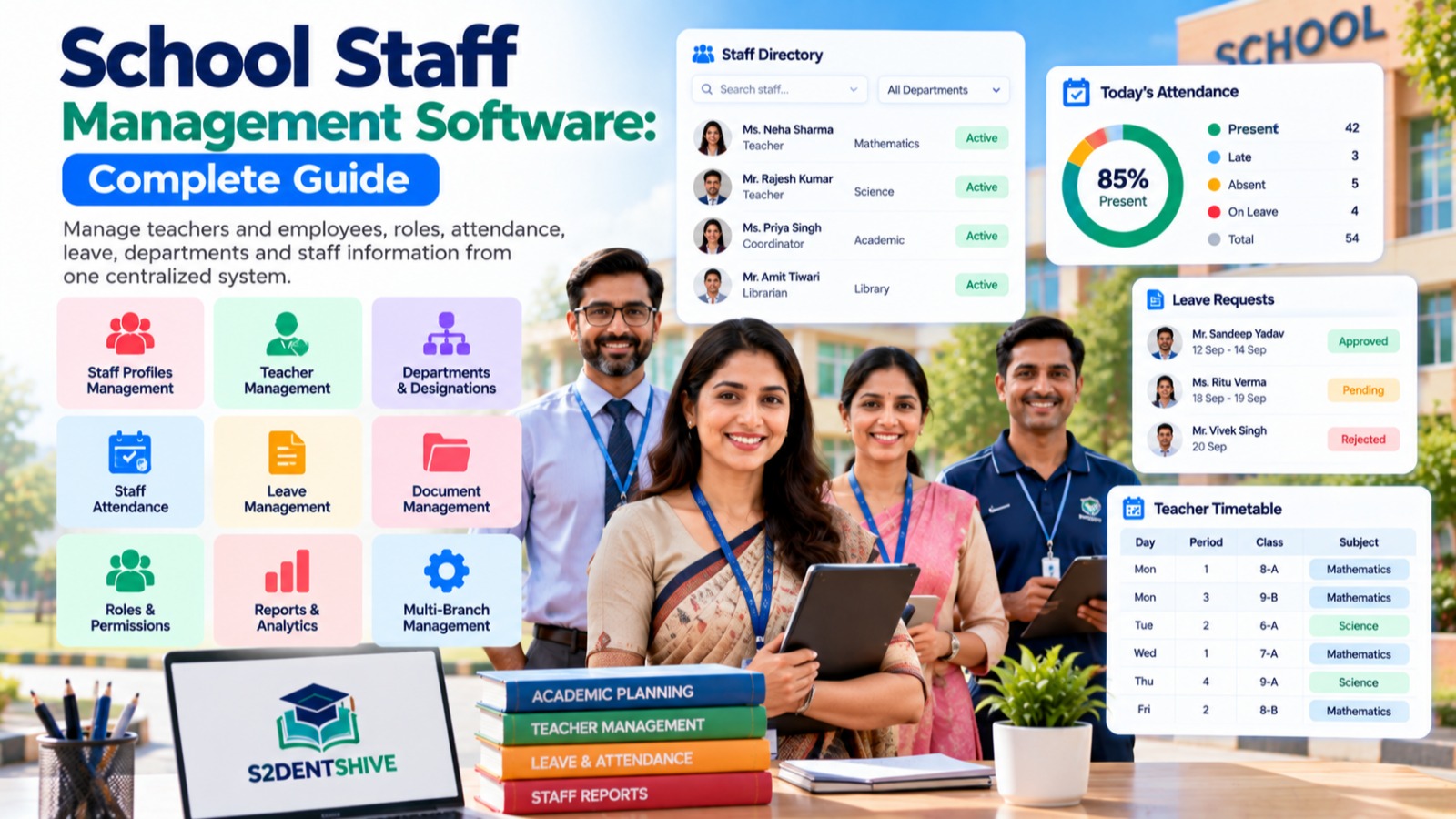

Managing school staff involves much more than maintaining a list of employees. Schools need to manage teachers, administrative employees, support staff, departments, roles, attendance, leave, employment details, documents, responsibilities, and performance-related information.
When these processes are managed through paper files, spreadsheets, and multiple applications, school administrators can spend significant time maintaining records and coordinating staff-related activities.
School Staff Management Software provides a centralized digital solution for managing teachers and other school employees. It helps schools maintain staff records, organize roles, manage attendance, track employment information, and connect staff operations with other School ERP modules.
Modern School ERP platforms such as S2DENTSHIVE provide staff management as part of a centralized school management system, allowing schools to manage staff along with students, admissions, attendance, fees, examinations, timetable, transport, hostel, and other operations.
What Is School Staff Management Software?
School Staff Management Software is a digital system designed to help educational institutions manage information and administrative processes related to their teachers and employees.
Instead of maintaining separate registers and spreadsheets for different staff-related activities, schools can maintain staff information through a centralized platform.
Depending on the software, schools can manage:
- Teacher profiles
- Administrative staff
- Support staff
- Staff roles
- Departments
- Employee records
- Employment information
- Staff attendance
- Leave management
- Teacher assignments
- Class responsibilities
- Documents
- Contact information
- Staff reports
- School-specific roles and permissions
The objective is to provide school administrators with a single source of staff information.
Why Do Schools Need Staff Management Software?
Teachers and employees are one of the most important resources of a school.
As a school grows, managing staff information manually becomes increasingly difficult.
A school may have:
- Principal
- Vice Principal
- Coordinators
- Teachers
- Accountants
- Receptionists
- Librarians
- Lab assistants
- Drivers
- Conductors
- Security staff
- Administrative employees
- Maintenance and support staff
Each employee may have different responsibilities, departments, working schedules, roles, and employment information.
Managing all of this through Excel files and paper records can lead to duplication, outdated information, and administrative delays.
Staff management software helps bring this information together.
Common Problems With Manual Staff Management
Schools that rely heavily on manual staff records may experience:
- Duplicate employee records
- Difficult staff searches
- Outdated contact information
- Manual attendance calculations
- Difficult leave tracking
- Unorganized employee documents
- Difficulty managing staff roles
- Multiple Excel files
- Delayed staff reports
- Difficulty tracking employment history
- Lack of centralized information
- Repeated administrative work
A centralized staff management system can help reduce these challenges.
Key Features of School Staff Management Software
A complete school staff management system should cover the complete employee lifecycle.
1. Centralized Staff Database
The system should provide a centralized database for teachers and employees.
Staff profiles can contain information such as:
- Employee name
- Contact information
- Address
- Date of joining
- Department
- Designation
- Role
- Employment status
- Assigned branch
- Academic responsibilities
- Documents
Administrators can quickly search and access staff information whenever required.
2. Teacher Management
Teachers are a major part of school operations.
Staff management software can help schools organize:
- Teacher profiles
- Subjects
- Classes
- Sections
- Class responsibilities
- Teacher roles
- Timetable assignments
- Attendance
- Leave
- Employment information
When teacher management is connected with the School ERP, information can be reused across multiple modules.
3. Staff Role and Designation Management
Different employees have different responsibilities.
For example:
- Principal
- Vice Principal
- Teacher
- Coordinator
- Accountant
- Librarian
- Receptionist
- Lab Assistant
- Driver
- Conductor
- Office Staff
A staff management system can allow administrators to assign appropriate roles and designations.
This helps schools maintain a structured organizational system.
4. Department Management
Schools can organize employees according to departments.
Examples include:
- Academic Department
- Administration
- Accounts
- Examination Department
- Library
- Transport
- Hostel
- IT
- Support Services
Department-based organization makes staff reporting and management easier.
5. Staff Attendance Management
Employee attendance is an important part of school administration.
A staff management system can help schools track:
- Daily attendance
- Check-in and check-out
- Present days
- Absent days
- Late arrivals
- Half days
- Leave
- Attendance reports
If attendance is integrated with other School ERP features, administrators can manage staff attendance without maintaining separate systems.
6. Leave Management
Teachers and employees may take different types of leave throughout the academic year.
A digital leave management system can help manage:
- Leave applications
- Leave types
- Leave duration
- Approval status
- Leave history
- Available leave
- Approved leave
- Rejected leave
This reduces the need for paper-based leave applications and manual registers.
7. Staff Documents Management
Schools often need to maintain employee documents.
These may include:
- Identity documents
- Qualification certificates
- Experience certificates
- Joining documents
- Address proof
- Photograph
- Appointment documents
- Other employment-related documents
A centralized staff system can make it easier for authorized administrators to locate employee records.
8. Employment Information
Staff management software can maintain important employment information such as:
- Date of joining
- Designation
- Department
- Employment type
- Branch
- Status
- Previous experience
- Responsibilities
- Employment history
This gives administrators a better overview of their workforce.
9. Staff Role and Permission Management
Not every employee should have access to every part of the School ERP.
For example:
Principal: Broad administrative access
Teacher: Student, attendance, timetable, homework and academic access
Accountant: Fees and financial access
Librarian: Library management access
Transport Manager: Transport-related access
Role-based permissions help schools control access to sensitive information.
10. Teacher-Class Assignment
Schools need to assign teachers to classes and sections.
The staff management system can work together with academic modules to organize:
- Class teachers
- Subject teachers
- Sections
- Subjects
- Academic responsibilities
This becomes particularly useful when the staff module is integrated with timetable and academic management.
11. Teacher Timetable Integration
Staff management becomes more useful when connected with the School Timetable module.
For example, administrators can manage:
Teacher → Subject → Class → Section → Timetable
Teachers can then have a structured view of their assigned classes and periods.
This reduces the need to maintain separate teacher assignment and timetable records.
12. Staff Search and Filters
A large school may have hundreds of employees.
The system should allow administrators to find staff quickly using filters such as:
- Name
- Department
- Designation
- Branch
- Employment status
- Role
- Subject
- Class
This can save significant administrative time.
13. Staff Reports
School administrators may need reports for different purposes.
A staff management system can provide reports such as:
- Staff directory
- Department-wise staff
- Designation-wise staff
- Teacher list
- Attendance reports
- Leave reports
- Employment reports
- Active/inactive staff
- Branch-wise staff
- Staff assignments
Digital reports make administrative decision-making easier.
14. Multi-Branch Staff Management
School groups may operate multiple branches.
Each branch may have its own:
- Teachers
- Administrators
- Departments
- Support staff
- Working schedules
A centralized School ERP can help manage branch-specific staff information while maintaining appropriate access controls.
15. Staff Communication
School employees frequently need to receive announcements and important information.
An integrated School ERP can connect staff management with communication features for:
- Notices
- Announcements
- Important updates
- Academic information
- Events
- Internal communication
This reduces dependency on multiple communication channels.
Benefits of School Staff Management Software
Implementing staff management software can provide several benefits for schools.
1. Centralized Employee Information
All important staff information can be maintained in one organized system.
2. Saves Administrative Time
Administrators do not have to repeatedly search through registers and spreadsheets.
3. Better Staff Organization
Teachers and employees can be organized according to roles, departments, branches, and responsibilities.
4. Improved Data Accuracy
Centralized records can reduce duplicate and inconsistent employee information.
5. Easier Attendance Management
Staff attendance can be recorded and reviewed digitally.
6. Better Leave Tracking
Leave applications and histories can be managed systematically.
7. Faster Staff Reports
Administrators can generate staff-related information without manually combining multiple spreadsheets.
8. Improved Access Control
Role-based permissions can help ensure that employees only access the information relevant to their responsibilities.
9. Better Coordination
When staff management is connected with timetable, attendance, academic, and communication modules, school operations become more connected.
School Staff Management Software vs Excel
Excel can be useful for maintaining a basic employee list, but it becomes difficult when staff management involves multiple processes.
| Feature | Excel/Manual System | Staff Management Software |
|---|---|---|
| Staff database | Yes | Yes |
| Teacher profiles | Yes | Yes |
| Role management | Manual | Structured |
| Department management | Manual | Yes |
| Staff attendance | Manual | Integrated |
| Leave management | Manual | Digital |
| Documents | Separate files | Centralized |
| Teacher assignments | Manual | Integrated |
| Timetable integration | Limited | Yes |
| Permissions | Limited | Role-based |
| Reports | Manual | Automated/structured |
| Multi-branch management | Difficult | Easier |
| School ERP integration | No | Yes |
The biggest advantage of dedicated software is that staff information can be connected with the rest of the school's operations.
How Staff Management Fits Into a School ERP
Staff management should not operate as an isolated module.
In a modern School ERP, staff information can connect with multiple school processes.
For example:
Staff → Subjects → Classes → Timetable → Attendance → Exams → Reports
A teacher's information can be used for:
- Class assignments
- Subject assignments
- Timetable
- Attendance
- Examination responsibilities
- Homework
- Communication
- Academic reports
This eliminates unnecessary duplication of employee information.
S2DENTSHIVE Provides School Staff Management Software
S2DENTSHIVE provides School Staff Management as part of its centralized School ERP platform.
Schools can manage teachers and other employees while connecting staff information with academic and administrative modules.
S2DENTSHIVE is designed to help schools manage multiple areas from one centralized system rather than depending on separate applications for every process.
Staff-related operations can be connected with features such as:
- Staff Management
- Teacher Management
- Student Management
- Admissions
- Attendance
- Camera Attendance
- Fees Management
- Examinations
- Report Cards
- Timetable Management
- Homework and Assignments
- Transport Management
- Hostel Management
- Library Management
- Inventory Management
- Events and Activities
- Expenses
- Communication
- Reports and Dashboards
- Live Classes
This integrated approach can help school owners and principals manage school operations more efficiently.
Why Use S2DENTSHIVE for School Staff Management?
One of the key advantages of S2DENTSHIVE is that staff management is connected with the wider School ERP ecosystem.
Instead of maintaining:
- One application for staff
- Another application for attendance
- Another for timetable
- Another for students
- Another for fees
- Another for examinations
schools can use a centralized School ERP system to manage these operations.
For example, a teacher's information can be connected with their:
Staff Profile → Role → Subject → Class → Timetable → Attendance → Academic Responsibilities
This reduces duplicate data entry and provides administrators with a more connected view of school operations.
How Schools Can Manage Staff Using S2DENTSHIVE
A typical staff management workflow can include the following steps.
Step 1: Add Staff
Create staff profiles with the required employee information.
Step 2: Assign Role and Designation
Assign the employee's appropriate role, designation, and department.
Step 3: Configure Permissions
Provide access according to the employee's responsibilities.
Step 4: Assign Academic Responsibilities
For teachers, connect relevant subjects, classes, and sections.
Step 5: Connect With Timetable
Assign teachers to their appropriate academic schedules.
Step 6: Manage Attendance
Track staff attendance through the School ERP's attendance capabilities.
Step 7: Manage Leave
Record and manage employee leave applications and history.
Step 8: Generate Reports
Use staff-related reports for administration and management.
Who Can Benefit From School Staff Management Software?
Staff management software can benefit:
- Private schools
- CBSE schools
- ICSE schools
- State board schools
- International schools
- K-12 schools
- School groups
- Multi-branch schools
- Educational institutions
It is particularly useful for schools with a large number of teachers and employees.
What Should Schools Look for in Staff Management Software?
Before selecting a School Staff Management System, school owners and administrators should consider the following features.
1. Complete Staff Profiles
The system should allow schools to maintain detailed employee information.
2. Role Management
It should support different staff roles and responsibilities.
3. Attendance
Staff attendance should be easy to record and monitor.
4. Leave Management
The software should support digital leave workflows.
5. Teacher Management
Schools should be able to manage subjects, classes, and teacher assignments.
6. Timetable Integration
Staff assignments should work with the school timetable.
7. Document Management
Employee-related documents should be organized and accessible to authorized users.
8. Access Control
Different employees should have appropriate permissions.
9. Reports
Administrators should be able to generate useful staff reports.
10. School ERP Integration
Staff management should ideally connect with student, attendance, timetable, examination, communication, and other modules.
Future of School Staff Management
School staff management is moving beyond basic employee databases.
Modern systems are increasingly focused on creating connected employee management environments.
Future developments may include:
- Automated staff scheduling
- AI-assisted timetable planning
- Digital employee onboarding
- Advanced attendance analytics
- Mobile staff applications
- Automated notifications
- Staff performance dashboards
- Workforce analytics
- Digital document management
- Integrated payroll and HR workflows
- Advanced role and permission management
The objective is to reduce administrative work while giving school management better visibility into their workforce.
Conclusion
Teachers and employees are at the center of school operations. Managing their information efficiently is therefore an important part of running a modern educational institution.
School Staff Management Software helps schools organize employee records, teacher assignments, roles, departments, attendance, leave, documents, permissions, and reports from a centralized system.
Instead of relying on multiple Excel files and disconnected applications, schools can use an integrated School ERP to connect staff management with academic and administrative operations.
S2DENTSHIVE provides School Staff Management Software as part of its centralized School ERP, helping schools manage staff alongside students, admissions, attendance, fees, examinations, timetable, transport, hostel, library, inventory, communication, live classes, and other school operations.
For school owners and principals, a centralized platform can provide a more organized approach to managing teachers, employees, and the wider school administration.
Comments (0)
Share your thoughts or ask a question about this article.
Leave a Comment