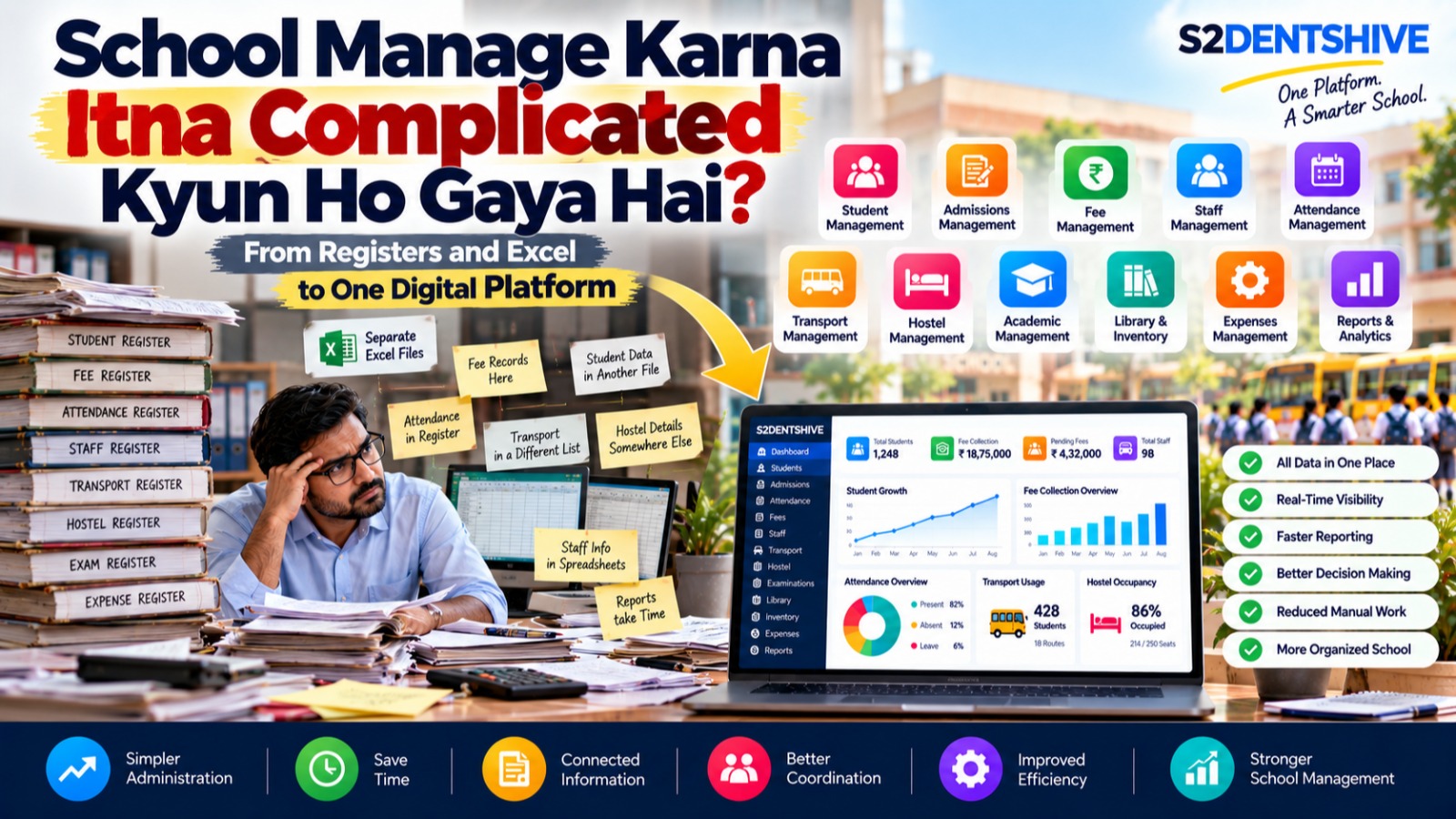

“Student ka record kahan hai?”
“Excel wali file mein check karo.”
“Fee kitni pending hai?”
“Accounts department se poochna padega.”
“Staff attendance bheji?”
“Sir, register mein hai.”
“Bus mein kaun-kaun se students hain?”
“Transport wali list check karni padegi.”
“Hostel mein kitni seats available hain?”
“Warden se confirm karna padega.”
If these conversations sound familiar, the problem may not be your school.
The problem may be the way school information is being managed.
Running a school has always required coordination. But as schools grow, the amount of information they generate grows even faster.
More students mean more records.
More staff means more attendance and employment information.
More admissions mean more enquiries and applications.
More students using transport mean more routes, vehicles, drivers and boarding points.
Hostel facilities create another layer of rooms, seats and student allocations.
Fee collection creates another large set of financial records.
Examinations, marks, report cards, inventory, expenses, events and communication add even more information.
And when all of this is managed through a combination of registers, Excel files, WhatsApp messages and multiple disconnected applications, school administration can become unnecessarily complicated.
This is where a centralized School ERP Software can make a significant difference.
S2DENTSHIVE brings important school operations together on one digital platform, helping schools move from scattered information to connected digital management.
School Manage Karna Itna Complicated Kab Ho Gaya?
Think about a small school.
There may be a limited number of students, teachers and administrative employees.
A simple student register may be enough.
A fee register can manage collections.
An attendance register can manage daily attendance.
A few Excel sheets may handle other information.
But schools rarely remain the same size forever.
As a school grows, it may add:
-
More students
-
More classes
-
More sections
-
More teachers
-
More administrative staff
-
More vehicles
-
More routes
-
Hostel facilities
-
More admissions
-
More examinations
-
More fee structures
-
More communication
-
More expenses
-
More inventory
The school becomes bigger.
But if the management system remains dependent on the same collection of registers and spreadsheets, administrative complexity increases.
The result is often:
More Data + More Departments + More Files = More Management Complexity
Registers Were Useful. But They Were Never Designed for Connected Management
Registers have been an important part of school administration for decades.
Student register.
Attendance register.
Fee register.
Staff register.
Transport register.
Hostel register.
Inventory register.
Exam register.
There is nothing inherently wrong with a register.
The problem begins when information needs to move between departments.
For example, one student's information may exist in:
-
Admission records
-
Student records
-
Attendance records
-
Fee records
-
Transport records
-
Hostel records
-
Examination records
If all these records are maintained independently, the school has several separate versions of information about the same student.
Now imagine updating a student's parent mobile number.
Does someone update it everywhere?
What happens if one department updates it while another does not?
This is how data inconsistency begins.
Then Came Excel
Excel changed school administration in many positive ways.
Lists became easier to manage.
Sorting became easier.
Filtering became possible.
Reports could be created faster.
Data could be stored digitally.
But eventually many schools started using Excel for almost everything.
You might find files such as:
Students.xlsx
Fees.xlsx
Staff.xlsx
Attendance.xlsx
Transport.xlsx
Hostel.xlsx
Expenses.xlsx
Admissions.xlsx
At first, this looks organized.
But as the number of files grows, another problem appears:
Which file is the latest?
Who updated it?
Is the information accurate?
Are two departments using the same data?
How do we combine all these files into one report?
Excel solves many individual tasks.
It does not automatically create a connected school management system.
The Real Problem Is Not Data. It Is Scattered Data.
Modern schools already generate enormous amounts of information.
The challenge is not necessarily collecting data.
The challenge is connecting it.
The accounts department has fee information.
The admission team has enquiry information.
Teachers have attendance and academic information.
The transport department has route information.
The hostel department has accommodation information.
The administration team has staff and operational information.
Management may receive reports from all of them.
But who connects everything?
Without a centralized system, school owners and administrators can spend a surprising amount of time simply finding and verifying information.
Imagine If the School Had One Clear Digital View
Imagine starting the day by opening one centralized dashboard.
Instead of searching through registers, spreadsheets and messages, management can see important information in one place.
Students
Current student strength and student-related activity.
Admissions
New enquiries, applications and admissions.
Fees
Collection, pending fees and payment activity.
Attendance
Student and staff attendance.
Staff
Employee and role-related information.
Transport
Vehicles, routes, drivers, conductors and student assignments.
Hostel
Rooms, seats, occupancy and student allocations.
Academics
Examinations, marks and report cards.
Expenses
Operational spending.
Inventory
Assets and available resources.
Now the management question changes.
Instead of:
“Where is the information?”
it becomes:
“What does the information tell us?”
That is the real purpose of digital school management.
S2DENTSHIVE: From Registers to One Digital Platform
S2DENTSHIVE is designed to help schools move beyond isolated registers and spreadsheets.
The idea is not simply to digitize individual records.
The larger objective is to create a connected school management environment.
Important areas can be managed through one platform, including:
-
Admissions
-
Student Management
-
Staff Management
-
Attendance
-
Fees
-
Fee Reminders
-
Payment Links
-
Timetable
-
Examinations
-
Marks
-
Report Cards
-
Transport
-
Hostel
-
Library
-
Inventory
-
Assets
-
Expenses
-
Events
-
Communication
-
Reports
-
Live Classes
The value comes from bringing these functions together.
1. One Student, One Digital Record
The student is at the center of school operations.
A single student may interact with almost every department.
The student's information can include:
-
Personal details
-
Parent and guardian details
-
Admission information
-
Class
-
Section
-
Attendance
-
Fees
-
Transport
-
Hostel
-
Examinations
-
Marks
-
Report cards
-
Activities
Instead of creating completely separate records for each department, a centralized system can connect these areas around the student.
The journey can look like:
Admission → Student Profile → Class → Attendance → Fees → Transport/Hostel → Exams → Marks → Report Card
This creates a much more complete digital student record.
2. Admissions: Start the Digital Journey From Day One
A student's digital journey should not begin only after admission.
It can begin with an enquiry.
The school may need to manage:
-
Enquiries
-
Applications
-
Parent information
-
Student information
-
Follow-ups
-
Admission status
-
Class preferences
-
Final admission
When admission information is connected with student management, the information collected during the admission process can become part of the student's continuing digital record.
This reduces repetitive data entry and creates better continuity.
3. Fees: From a Register to a Complete Financial View
Fee management is one of the most important administrative activities in a school.
But fee management involves much more than recording payments.
Schools may need to manage:
-
Fee structures
-
Fee groups
-
Fee terms
-
Student fee assignments
-
Discounts
-
Payments
-
Receipts
-
Pending fees
-
Reminders
-
Payment links
-
Collection reports
With centralized fee management, authorized users can get a clearer view of the school's financial position.
Instead of asking:
“Kitni fees collect hui?”
management can also ask:
“Kitni pending hai?”
“Kahan outstanding zyada hai?”
“Collection trend kaisa hai?”
This turns fee information into a management resource.
4. Staff Management: Stop Maintaining Employee Information in Multiple Places
Teachers and employees are the people who keep the school running.
Their information should also be organized.
A school may need to manage:
-
Employee profiles
-
Roles
-
Departments
-
Employment information
-
Attendance
-
Responsibilities
-
Assignments
When staff information exists in separate files, it can become difficult to maintain a current picture of the workforce.
A centralized staff management environment helps administrators organize this information more efficiently.
5. Attendance: More Than Present and Absent
Attendance is one of the most frequently used school processes.
Traditional attendance often means:
Mark in Register → Calculate → Prepare Report → Share With Management
A digital attendance system can make the process more structured.
S2DENTSHIVE supports digital attendance management, including camera-based attendance capabilities where applicable.
Attendance can then become part of the larger student and staff information system.
Management can gain visibility into:
-
Student attendance
-
Staff attendance
-
Class-wise attendance
-
Attendance patterns
-
Absence trends
6. Transport: Connect Students With Routes and Vehicles
School transport is another area where disconnected records can create unnecessary work.
Transport management can involve:
-
Vehicles
-
Routes
-
Boarding points
-
Drivers
-
Conductors
-
Students
-
Trips
Instead of maintaining a student transport list separately from student records, a centralized platform can connect these relationships.
For example:
Student → Boarding Point → Route → Vehicle → Driver/Conductor
This makes transport information easier to organize and access.
7. Hostel Management: From Registers to Occupancy Visibility
Schools with hostel facilities have another layer of information to manage.
This may include:
-
Hostels
-
Rooms
-
Seats
-
Student allocations
-
Occupancy
-
Vacancies
A hostel register may record all this information.
But management often needs quick answers.
How many seats are occupied?
How many are vacant?
Which student is assigned to which room?
Digital hostel management can make this information easier to organize and review.
8. Academics: Connect Timetable, Exams and Results
School management cannot be separated from academics.
Schools need to manage:
-
Classes
-
Sections
-
Subjects
-
Teachers
-
Timetables
-
Examinations
-
Marks
-
Report cards
When these activities are managed digitally within the same school environment, academic information becomes part of the student's broader digital journey.
This reduces the need to maintain isolated academic spreadsheets.
9. Expenses: Understand Where the Money Is Going
Fee collection shows one side of the school's finances.
Expenses show the other.
Schools may spend money on:
-
Transport
-
Maintenance
-
Events
-
Inventory
-
Utilities
-
Administration
-
Infrastructure
-
Other operations
Centralized expense management helps management organize this information and understand spending more clearly.
This gives school owners a broader financial picture:
Income + Expenses = Better Financial Visibility
10. Inventory and Assets: Know What the School Owns
A school is also responsible for a large number of physical resources.
These can include:
-
Furniture
-
Computers
-
Laboratory equipment
-
Books
-
Sports equipment
-
Office supplies
-
Other assets
Without proper inventory management, it can be difficult to know what is available, what has been purchased and what needs attention.
Digital inventory and asset management can make this information easier to maintain.
11. Communication: Move Beyond Scattered Messages
Schools communicate with:
-
Students
-
Parents
-
Teachers
-
Staff
-
Management
Communication may involve:
-
Notices
-
Fee reminders
-
Attendance
-
Events
-
Academic information
-
Announcements
A centralized school management platform can help organize communication as part of the larger school ecosystem.
This is more structured than depending entirely on individual messages and separate communication channels.
12. Reports: Stop Building Everything Manually
One of the biggest administrative time consumers is report preparation.
Management may ask for:
-
Student report
-
Fee report
-
Attendance report
-
Staff report
-
Transport report
-
Hostel report
-
Expense report
-
Academic report
If every department maintains separate files, employees have to collect and combine information manually.
Centralized data reduces this dependency.
Relevant information is already organized within the system, making reports and dashboards more useful for management.
13. One Platform Can Reduce Repetitive Data Entry
Consider what happens when a student is admitted.
In a disconnected environment, employees may enter the same information into:
-
Admission file
-
Student spreadsheet
-
Fee system
-
Transport list
-
Hostel register
-
Attendance system
The same information is entered repeatedly.
This creates:
More Work + More Errors + More Inconsistency
With connected digital management, core student information can become available across relevant areas of the platform.
This reduces unnecessary duplication.
14. One Platform Does Not Mean Everyone Gets Access to Everything
Centralization does not mean every employee should see every piece of information.
Different users can have different responsibilities and access.
For example:
Accounts Team → Fees
Teachers → Relevant Academic & Attendance Information
Transport Team → Transport Information
Hostel Team → Hostel Information
Administrators → Operational Information
Management → Broader School Visibility
This allows the school to maintain structured access while still working from a common digital environment.
15. What Happens When the School Owner Needs an Answer?
Consider a simple question:
“How many students are currently using school transport?”
In a traditional system:
Ask transport team.
Wait for the list.
Check student records.
Verify the number.
Now consider:
“How much fee is pending from those students?”
Another department may need to be involved.
This is how simple questions become complicated.
With connected information, relationships between students, fees and transport can be easier to understand.
The goal is not simply faster reporting.
It is better management visibility.
16. School Owners Should Manage the School, Not Search for Information
A school owner's time is valuable.
They should be thinking about:
-
Student growth
-
Academic quality
-
Parent satisfaction
-
Staff development
-
Infrastructure
-
Financial planning
-
School expansion
They should not spend large amounts of time searching through files for basic information.
A centralized School ERP can shift management from:
Information Searching
to
Information-Based Decision Making
17. The Difference Between Digital Records and Digital Management
There is an important difference.
Digital Records
The school has:
-
Excel files
-
PDFs
-
Online forms
-
Digital documents
-
Separate applications
The information is digital, but may still be disconnected.
Digital Management
The school has:
-
Centralized information
-
Connected workflows
-
Role-based access
-
Dashboards
-
Reports
-
Integrated departments
-
Digital processes
The information is not only stored digitally.
It is used to manage the school.
That is the real goal.
18. Why Schools Need to Move Beyond Excel
Excel will always have its place.
It is useful for many tasks.
But a complete school management operation involves relationships between thousands of records.
Students connect to classes.
Students connect to fees.
Students connect to attendance.
Students connect to transport.
Students connect to hostel.
Teachers connect to subjects.
Staff connect to attendance.
Vehicles connect to routes.
Expenses connect to operations.
A spreadsheet is not naturally designed to manage an entire connected ecosystem.
A School ERP is.
19. The Real Benefit of One Digital Platform
The biggest advantage is not simply convenience.
It is connected information.
One platform can provide:
Better Visibility
Management can see more of the school.
Less Repetitive Work
Employees do not need to enter the same information repeatedly.
Better Coordination
Departments work with connected information.
Faster Reporting
Management can access structured information more easily.
Better Accuracy
Centralized records can reduce inconsistencies.
Better Decisions
Management can use actual information instead of assumptions.
Greater Scalability
The system can support the school as operations grow.
20. S2DENTSHIVE: One Centralized Platform for School Management
S2DENTSHIVE brings multiple school functions into one digital environment.
Schools can manage:
-
Admissions
-
Students
-
Staff
-
Attendance
-
Fees
-
Fee Reminders
-
Payment Links
-
Timetable
-
Examinations
-
Marks
-
Report Cards
-
Transport
-
Hostel
-
Library
-
Inventory
-
Assets
-
Expenses
-
Events
-
Communication
-
Reports
-
Live Classes
Instead of using technology as a collection of separate tools, schools can use it as a connected management system.
From Registers and Excel to One Connected School
The transformation can be simple to understand.
Yesterday
Register → Excel → WhatsApp → Manual Report → Department Confirmation
Tomorrow
Digital Entry → Centralized Data → Dashboard → Report → Insight → Action
The objective is not to eliminate people.
The objective is to eliminate unnecessary manual work.
Teachers should teach.
Accounts teams should manage finances.
Administrators should manage operations.
Transport teams should manage transport.
Hostel teams should manage accommodation.
And school owners should have the visibility required to make decisions.
A Practical Digital School Workflow
Imagine a student joins the school.
Step 1 — Admission
The student's enquiry and admission information is recorded.
Step 2 — Student Profile
The student's central profile is created.
Step 3 — Class
The student is assigned to the appropriate class and section.
Step 4 — Fees
The applicable fee structure is assigned.
Step 5 — Attendance
Daily attendance becomes part of the student's record.
Step 6 — Transport
If required, transport information is assigned.
Step 7 — Hostel
If applicable, hostel allocation is recorded.
Step 8 — Academics
Examinations and marks become part of the academic record.
Step 9 — Report Card
Academic performance can be maintained within the same ecosystem.
Instead of creating separate records at every stage, the student has one connected digital journey.
The Future Is Not More Applications
Many schools believe digital transformation means adding another application every time a new requirement appears.
Need fees?
Add an application.
Need attendance?
Add another.
Need transport?
Add another.
Need communication?
Add another.
Need admissions?
Add another.
Eventually, the school has many applications—but still has the same problem.
Disconnected information.
The better approach is to build a centralized digital foundation.
One School. One Digital Platform. One Clear View.
School management will always involve complexity.
Students need attention.
Teachers need support.
Parents need communication.
Fees need to be collected.
Staff need to be managed.
Transport needs coordination.
Hostels need administration.
Examinations need organization.
Expenses need monitoring.
But technology should not add unnecessary complexity.
It should remove it.
S2DENTSHIVE brings important school operations together so that schools can move from:
Registers → Excel → Scattered Applications
to:
One Centralized Digital Platform
Conclusion: School Management Should Be Simpler
School management is complex because a school is a complex organization.
But managing information does not have to be unnecessarily complicated.
When important information is scattered across registers, Excel files, WhatsApp messages and separate applications, employees spend too much time searching, checking, copying and reporting.
A centralized school ERP can change this approach.
S2DENTSHIVE helps bring students, admissions, fees, staff, attendance, academics, transport, hostel, library, inventory, expenses, communication and administration together within one digital school management environment.
The goal is not simply to replace paper.
The goal is to create a school where information is:
Connected.
Organized.
Accessible.
Reliable.
Useful.
And most importantly, actionable.
Because the future of school management is not about having more registers, more Excel files or more applications.
It is about having one digital platform that helps the entire school work together.
Comments (0)
Share your thoughts or ask a question about this article.
Leave a Comment