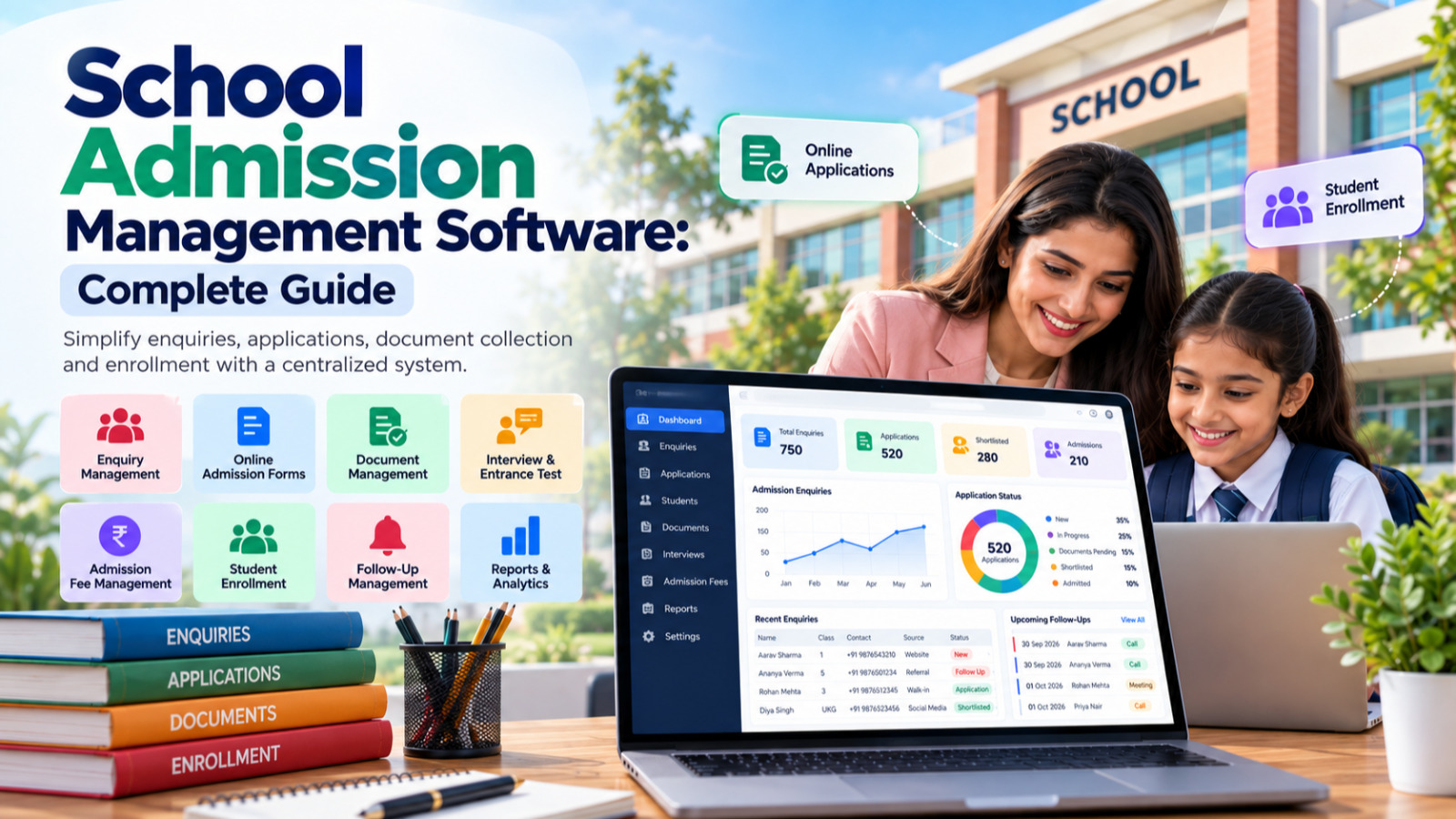

Admissions are one of the most important processes for every educational institution.
Every admission cycle involves multiple activities, including handling enquiries, collecting applications, communicating with parents, verifying documents, conducting follow-ups, allocating students to classes, collecting admission fees, and maintaining student records.
When these activities are managed using paper forms, registers, spreadsheets, phone calls, and multiple disconnected applications, the admission process can become difficult to monitor and manage.
This is where School Admission Management Software can make a significant difference.
A modern admission management system helps schools organize the complete admission journey in one centralized platform—from the first enquiry to successful enrollment.
For school owners and principals, it provides better visibility into the admission pipeline. For admission teams, it reduces repetitive administrative work. For parents, it can provide a simpler and more convenient application experience.
What Is School Admission Management Software?
School Admission Management Software is a digital platform designed to help educational institutions manage and automate their student admission processes.
Depending on the system, it can help schools manage:
-
Admission enquiries
-
Lead management
-
Online registration
-
Admission applications
-
Student information
-
Parent and guardian details
-
Document collection
-
Application verification
-
Follow-ups
-
Admission status
-
Entrance tests
-
Interviews
-
Class and section allocation
-
Admission fees
-
Enrollment
-
Communication
-
Admission reports
Instead of maintaining admission information in multiple Excel sheets or physical registers, schools can manage the information through a centralized system.
When admission management is part of a complete School ERP, the newly admitted student's information can also flow into other modules such as student management, fees, attendance, transport, hostel, examinations, and communication.
Why Do Schools Need Admission Management Software?
The admission process can generate a large amount of information.
For example, a school may receive hundreds or thousands of enquiries during an admission season.
Each enquiry may require:
-
Recording parent information
-
Capturing student details
-
Identifying the class requested
-
Following up with parents
-
Sharing admission information
-
Collecting the application
-
Verifying documents
-
Scheduling an interview or test
-
Updating the application status
-
Completing enrollment
If these activities are maintained manually, it can become difficult to know exactly where every applicant stands.
A centralized admission management system can organize this information and provide a clear view of the admission pipeline.
School Admission Process With Traditional Methods
A traditional admission process may involve:
-
Paper enquiry forms
-
Excel files
-
Printed admission forms
-
Manual phone calls
-
WhatsApp conversations
-
Separate document folders
-
Manual follow-up lists
-
Physical receipts
-
Multiple registers
This approach can create challenges such as:
-
Duplicate entries
-
Lost information
-
Missed follow-ups
-
Difficulty tracking applications
-
Repetitive data entry
-
Slow reporting
-
Limited management visibility
As the number of applicants increases, these problems can become more difficult to manage.
How School Admission Software Simplifies the Process
A digital admission system can bring the complete admission workflow into one place.
A typical process can look like:
Enquiry → Registration → Application → Documents → Verification → Test/Interview → Approval → Fee Payment → Enrollment
Each stage can be tracked through the system.
This allows admission staff and management to understand which applications are pending, which have been approved, and which applicants require follow-up.
Key Features of School Admission Management Software
1. Admission Enquiry Management
The admission process often begins with an enquiry.
Parents may contact the school through:
-
Website
-
Phone
-
Walk-in visits
-
Social media
-
Online forms
-
Referrals
-
Campaigns
An admission management system can record these enquiries in a structured format.
Typical information may include:
-
Student name
-
Parent name
-
Contact number
-
Email
-
Class interested in
-
Previous school
-
Source of enquiry
-
Enquiry date
-
Remarks
-
Follow-up date
-
Admission status
This creates a centralized database of prospective students.
2. Admission Lead Tracking
Not every enquiry immediately becomes an admission.
Some parents may require several follow-ups before completing the application.
A School Admission CRM can help track the journey of each enquiry.
For example:
New Enquiry
↓
Contacted
↓
Interested
↓
Application Started
↓
Documents Submitted
↓
Interview/Test
↓
Approved
↓
Admission Completed
This makes it easier for admission teams to identify the next action for each applicant.
3. Online Admission Forms
Online admission forms can reduce paperwork for both parents and school staff.
Instead of visiting the school to collect a physical form, parents can enter information digitally.
The form may collect:
-
Student details
-
Date of birth
-
Gender
-
Parent details
-
Contact information
-
Previous school information
-
Address
-
Academic information
-
Medical information
-
Documents
Once submitted, the information can be stored directly in the admission system.
4. Centralized Student Information
Admission teams often have to enter the same information multiple times.
For example, student information may initially be entered into an enquiry register and later into an admission register and then into the main student database.
An integrated School ERP can reduce this duplication.
Once the admission is confirmed, the applicant's information can be converted into a student record, depending on the system's workflow.
This saves time and reduces repeated data entry.
5. Parent and Guardian Management
A student's admission record is closely connected with parents and guardians.
Admission software can maintain information such as:
-
Father's name
-
Mother's name
-
Guardian name
-
Mobile numbers
-
Email addresses
-
Occupation
-
Address
-
Relationship with student
Keeping parent and guardian information structured makes future communication easier.
6. Document Management
Admissions often require several documents.
These may include:
-
Birth certificate
-
Previous school certificate
-
Transfer certificate
-
Address proof
-
Identity documents
-
Photographs
-
Medical documents
-
Academic records
-
Other school-specific documents
A digital admission system can allow documents to be uploaded and associated with the applicant.
The admission team can then review whether the required documents have been submitted.
This reduces dependency on physical folders.
7. Document Verification
Collecting documents is only one part of the admission process.
Schools also need to verify them.
An admission system can help maintain document status such as:
-
Submitted
-
Pending
-
Verified
-
Rejected
-
Requires correction
This provides admission staff with a clear overview of incomplete applications.
8. Admission Status Management
Every applicant should have a clear status.
For example:
-
New
-
Contacted
-
Follow-up Required
-
Application Received
-
Documents Pending
-
Documents Verified
-
Test Scheduled
-
Interview Scheduled
-
Selected
-
Rejected
-
Waiting List
-
Admission Confirmed
Status-based workflows make it easier for admission teams to manage large numbers of applications.
9. Follow-Up Management
Follow-ups are one of the most important parts of the admission process.
A parent may enquire today but decide to complete the application several days later.
Without proper follow-up tracking, admission teams may forget to contact interested parents.
Admission software can help maintain:
-
Follow-up date
-
Follow-up remarks
-
Assigned staff member
-
Next action
-
Communication history
-
Current status
This makes the admission process more systematic.
10. Admission Counsellor Management
Larger schools may have multiple admission counsellors or executives.
The software can assign enquiries to individual team members.
For example:
Counsellor A
-
45 enquiries
-
25 contacted
-
15 follow-ups
-
8 applications
-
5 admissions
Counsellor B
-
40 enquiries
-
30 contacted
-
12 follow-ups
-
10 applications
-
7 admissions
Such information can help management monitor the admission team's workload and activities.
11. Admission Source Tracking
Schools often receive enquiries from multiple sources.
For example:
-
Website
-
Google
-
Social media
-
Referral
-
Existing parents
-
Walk-in
-
Advertisement
-
Education fairs
Admission software can record the source of each enquiry.
Over time, schools can analyze which channels are generating enquiries and admissions.
This can help management evaluate its admission campaigns.
12. Entrance Test Management
Some schools conduct entrance tests before confirming admission.
An admission system can help manage:
-
Test schedules
-
Applicants
-
Subjects
-
Marks
-
Results
-
Selection status
This keeps the test information connected with the applicant's admission record.
13. Interview Management
Schools may also conduct student or parent interviews.
The system can help track:
-
Interview date
-
Interviewer
-
Applicant
-
Remarks
-
Result
-
Next action
This avoids maintaining separate interview registers.
14. Class and Section Allocation
Once an applicant is approved, the student may need to be assigned to a class and section.
An integrated School ERP can connect the admission process with:
-
Academic year
-
Class
-
Section
-
Student profile
This reduces the need to enter the same information again after admission confirmation.
15. Admission Fee Management
Admission may involve one-time or initial payments.
The admission system can connect with the school's fee management module to manage:
-
Admission fees
-
Registration fees
-
Initial installments
-
Discounts
-
Payment status
-
Receipts
This creates a smoother transition between admission and fee collection.
16. Automated Communication
Communication is an important part of the admission process.
Schools may need to inform parents about:
-
Application submission
-
Missing documents
-
Interview dates
-
Entrance test dates
-
Selection
-
Admission confirmation
-
Payment deadlines
-
Important instructions
Depending on the platform, these communications can be sent through supported channels such as SMS, email, notifications, or messaging integrations.
Automation can reduce the amount of repetitive communication handled manually by staff.
17. Admission Dashboard
A centralized dashboard gives school management an overview of the admission process.
Important indicators may include:
-
Total enquiries
-
New enquiries
-
Applications received
-
Applications pending
-
Documents pending
-
Interviews scheduled
-
Selected applicants
-
Confirmed admissions
-
Rejected applications
-
Pending follow-ups
Management can use this information to understand the current admission pipeline.
18. Admission Reports
Reports are essential for monitoring admission performance.
A School Admission Management System can provide reports such as:
Enquiry Report
Shows all admission enquiries received during a selected period.
Application Report
Shows submitted applications and their current status.
Pending Follow-Up Report
Shows applicants who require follow-up.
Class-Wise Admission Report
Shows applications and confirmed admissions by class.
Source-Wise Admission Report
Shows where enquiries are coming from.
Counsellor-Wise Report
Shows enquiries and admissions handled by each counsellor.
Admission Conversion Report
Shows the movement from enquiries to applications and confirmed admissions.
These reports can save considerable time compared with manually preparing reports from multiple Excel files.
Benefits of School Admission Management Software
A properly implemented admission system can benefit different stakeholders.
Benefits for School Owners
-
Better visibility into admissions
-
Centralized admission data
-
Easier monitoring of admission targets
-
Better understanding of enquiry sources
-
Faster reports
Benefits for Principals
-
Admission pipeline visibility
-
Class-wise admission information
-
Application status monitoring
-
Better coordination with admission teams
Benefits for Admission Teams
-
Organized enquiry management
-
Follow-up reminders
-
Centralized applicant information
-
Document tracking
-
Less repetitive data entry
Benefits for Parents
-
Convenient online application
-
Easier document submission
-
Faster communication
-
Clear application status
-
Reduced need for repeated school visits
School Admission Software vs. Excel
Many schools initially manage admissions using Excel.
Excel can be useful for basic data collection, but managing a large admission pipeline through spreadsheets can become difficult.
| Excel-Based Admission Management | Admission Management Software |
|---|---|
| Multiple spreadsheets | Centralized database |
| Manual enquiry tracking | Structured enquiry management |
| Manual follow-ups | Follow-up tracking |
| Separate document folders | Digital document management |
| Manual status updates | Admission workflow |
| Manual reports | Automated reports |
| Limited user permissions | Role-based access |
| Repeated data entry | Integrated student records |
| Limited communication automation | Automated communication options |
| Difficult management overview | Admission dashboard |
The main advantage of dedicated admission software is the ability to manage the entire admission workflow, rather than simply storing applicant information.
How Admission Management Integrates With School ERP
The admission process does not end when the student is enrolled.
Once admission is confirmed, the student becomes part of the school's daily operations.
This is where an integrated School ERP becomes particularly useful.
The admission record can connect with:
Admission
↓
Student Management
↓
Fee Management
↓
Attendance
↓
Academics
↓
Examinations
↓
Transport / Hostel
↓
Reports
Instead of transferring information manually between departments, an integrated platform can maintain the student's information throughout the school lifecycle.
How S2DENTSHIVE Helps Manage School Admissions
S2DENTSHIVE provides an integrated approach to school admission and student management.
Schools can organize their admission process through features such as:
-
Admission enquiries
-
Admission CRM
-
Applicant information
-
Parent and guardian details
-
Online admission workflows
-
Document management
-
Follow-up tracking
-
Admission status
-
Class allocation
-
Student conversion
-
Fee integration
-
Admission reports
-
Dashboard and analytics
Once admission is completed, student information can become part of the wider school management ecosystem.
This allows schools to connect admissions with other important operations such as:
-
Student management
-
Fee management
-
Attendance
-
Examinations
-
Timetable
-
Staff management
-
Transport
-
Hostel
-
Library
-
Inventory
-
Communication
-
Events
-
Reports
The objective is to eliminate the need to manage every department through a separate application.
How to Improve the School Admission Process
Technology alone does not guarantee a successful admission process.
Schools should also establish clear workflows.
Here are some practical steps.
1. Define the Admission Workflow
Clearly define each stage from enquiry to enrollment.
For example:
Enquiry → Follow-Up → Application → Documents → Verification → Interview/Test → Selection → Fee Payment → Admission
2. Assign Responsibilities
Make sure every enquiry and application has an assigned team member.
3. Track Follow-Ups
Do not rely on memory or WhatsApp conversations to track prospective parents.
4. Standardize Required Documents
Maintain a clear list of documents required for each admission category.
5. Use Automated Communication
Automate routine notifications where appropriate.
6. Monitor Admission Reports
Management should regularly review enquiries, applications, pending follow-ups, and confirmed admissions.
7. Avoid Duplicate Data Entry
Whenever possible, information should flow from enquiry to application and then into the student record.
What Should Schools Look for in Admission Management Software?
Before choosing an admission system, schools should evaluate:
Ease of Use
The software should be easy for admission staff to understand and operate.
Workflow Flexibility
Every school has different admission rules, so the software should accommodate the institution's workflow.
Document Management
Check how applicant documents are stored and accessed.
Communication
Review available SMS, email, notification, or messaging integrations.
Reports
Ensure the system provides the admission reports required by management.
Security
Student and parent information should be protected through appropriate authentication, permissions, backups, and security controls.
Integration
Admission software is more useful when it can connect with student management, fees, attendance, and other ERP modules.
Scalability
The system should support the school's future growth and potentially multiple branches.
Support
Implementation, training, onboarding, and technical support should also be considered.
The Future of School Admissions Is Digital
Parents increasingly expect educational institutions to provide convenient and transparent digital experiences.
The admission process is often the first major interaction between a family and a school.
A well-organized digital admission process can help schools provide:
-
Faster communication
-
Easier applications
-
Better document management
-
Clear application tracking
-
More organized follow-ups
-
Better management visibility
At the same time, schools can reduce administrative workload and maintain better records.
The goal is not simply to move the admission form from paper to a website.
The real objective is to digitize the complete admission journey.
Conclusion
School admissions involve much more than collecting an application form.
Schools need to manage enquiries, follow-ups, applications, documents, tests, interviews, selections, fees, communication, and final enrollment.
Managing these activities manually can become increasingly difficult as the number of applicants grows.
School Admission Management Software provides a centralized way to organize and automate the complete admission process.
With features such as enquiry management, online applications, document management, follow-up tracking, admission status, communication, reports, dashboards, and fee integration, schools can make their admission operations more structured and efficient.
When admission management is integrated with a complete School ERP, the benefits extend beyond the admission season. Student information can continue through fees, attendance, academics, examinations, transport, hostel, communication, and other school operations.
For school owners and principals looking to simplify admissions and reduce dependence on spreadsheets and disconnected applications, an integrated platform such as S2DENTSHIVE can provide a centralized solution.
From the first enquiry to successful enrollment—manage the complete admission journey from one system.
Comments (0)
Share your thoughts or ask a question about this article.
Leave a Comment