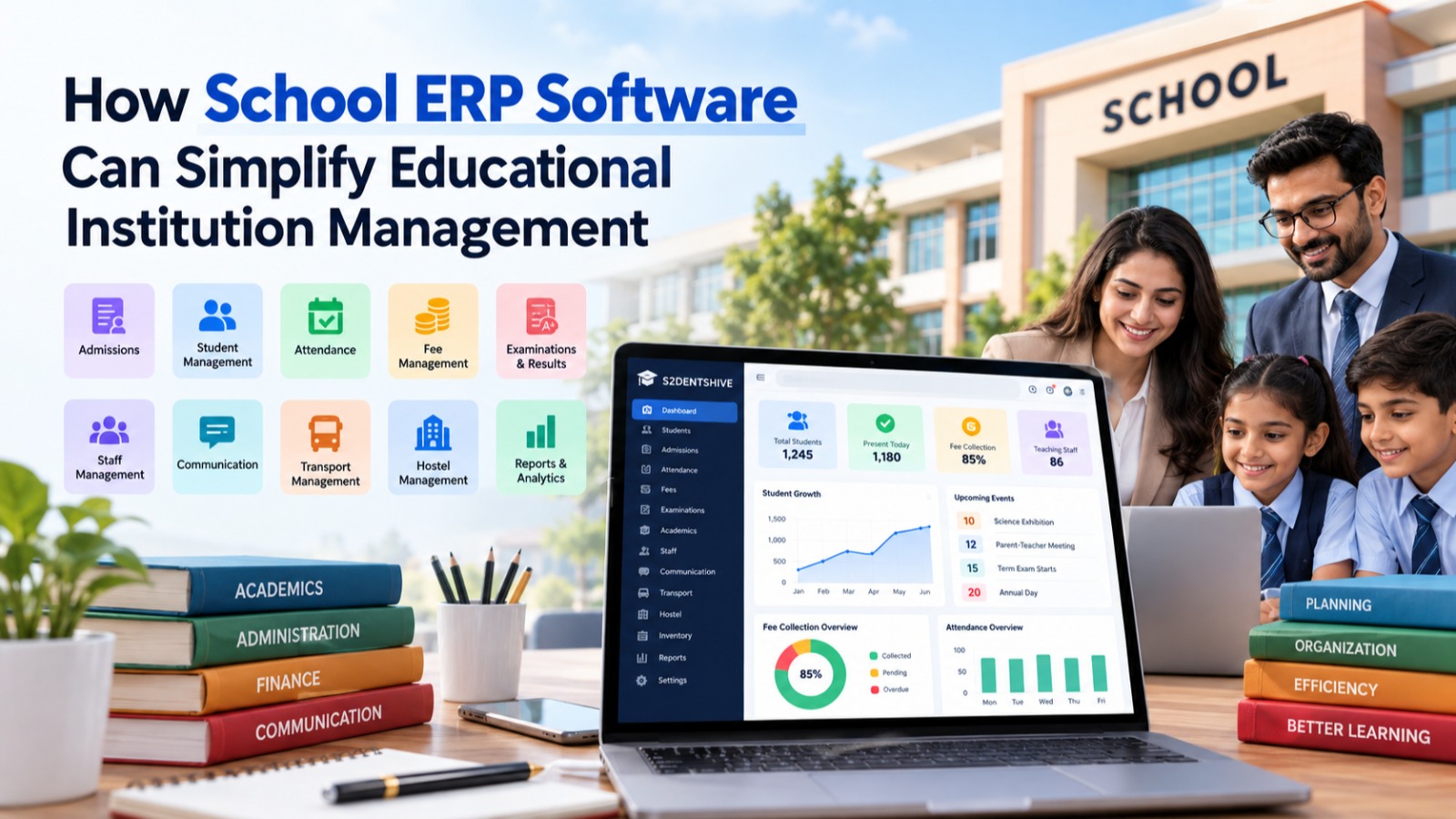

Managing an educational institution involves much more than teaching students. School administrators and principals have to manage admissions, student records, attendance, fees, examinations, staff, communication, transportation, inventory, events, and many other daily activities.
When these processes are managed through paper registers, spreadsheets, separate applications, and manual communication, it can become difficult to maintain accurate information and coordinate different departments.
This is where School ERP Software can make a significant difference.
A School ERP brings multiple academic, administrative, and financial processes together in a centralized platform. Instead of depending on disconnected systems, schools can manage their day-to-day operations through a single integrated solution. Modern school management platforms commonly connect areas such as admissions, attendance, fees, examinations, timetables, staff management, communication, and reporting.
What Is School ERP Software?
School ERP Software is an integrated digital platform designed to manage and automate the various operations of an educational institution.
ERP stands for Enterprise Resource Planning. In the education sector, this concept is adapted to manage school-specific activities such as:
-
Student admissions
-
Student information
-
Attendance management
-
Fee management
-
Examination and results
-
Timetable management
-
Homework and academic activities
-
Staff and HR management
-
Payroll
-
Parent communication
-
Transport management
-
Library management
-
Hostel management
-
Inventory management
-
Events and activities
-
Reports and analytics
The main objective is to bring these functions together so that information can be managed from one centralized system instead of being maintained across multiple disconnected tools.
An integrated database and modular structure are important characteristics of ERP systems because information can be shared across different functions of an institution.
Why Do Educational Institutions Need School ERP Software?
Traditional school management often involves multiple registers, Excel files, paper documents, messaging applications, and separate software.
For example, the admission department may maintain student information in one file, the accounts department may maintain fee records somewhere else, teachers may maintain attendance separately, and management may have to request reports from different departments.
This creates several challenges:
-
Duplicate data entry
-
Increased administrative workload
-
Difficulty finding information
-
Communication gaps
-
Delays in generating reports
-
Greater possibility of manual errors
-
Limited visibility for school management
-
Difficulty tracking pending activities
School ERP software addresses these challenges by connecting important workflows and providing different users with access to the information they need.
1. Simplifies Student Admission Management
Admissions are one of the most important processes for every educational institution.
Managing enquiries through notebooks, spreadsheets, phone calls, and separate documents can make it difficult to track prospective students.
A School ERP with an admission management module can help institutions manage:
-
Admission enquiries
-
Student registration
-
Online admission forms
-
Application tracking
-
Document collection
-
Class and section allocation
-
Admission status
-
Student profiles
The admission team can maintain a structured record of enquiries and applications instead of depending on multiple spreadsheets or physical files.
This also helps school management understand the status of the admission process from a centralized dashboard.
2. Makes Student Information Management Easier
A school generates a large amount of information about every student.
This may include:
-
Personal information
-
Parent and guardian details
-
Academic records
-
Attendance
-
Fee information
-
Examination results
-
Documents
-
Transport details
-
Hostel information
-
Certificates and other records
Managing this information manually can become increasingly difficult as the number of students grows.
School ERP software provides a centralized student information system where authorized users can access relevant information when required.
This reduces the need to maintain the same information in multiple locations.
3. Automates Attendance Management
Attendance is a daily activity, and teachers spend considerable time recording and managing it.
A digital attendance system can simplify the process by allowing teachers or authorized staff to record attendance electronically.
Depending on the ERP platform, attendance can be connected with:
-
Student profiles
-
Classes and sections
-
Attendance reports
-
Parent notifications
-
Monthly attendance summaries
-
Staff attendance
-
Management dashboards
Some modern school ERP platforms also support digital or camera-based attendance technologies.
The result is a more organized attendance process with less dependency on paper registers.
4. Simplifies Fee Collection and Management
Fee management is another major responsibility for school administration.
A school may have multiple fee categories, payment schedules, discounts, fines, concessions, and payment methods.
Managing all of this manually can make fee collection and reconciliation time-consuming.
A School ERP can help manage:
-
Fee structures
-
Student fee assignments
-
Installments
-
Discounts
-
Late fees
-
Pending fees
-
Fee receipts
-
Online payments
-
Payment links
-
Fee reminders
-
Collection reports
Parents can receive reminders about upcoming or overdue payments, while the accounts department can view payment status from a centralized system.
Online fee payment and automated reminders are among the commonly cited benefits of modern school management systems.
5. Improves Examination and Result Management
Examinations involve multiple steps, from scheduling examinations to entering marks and generating report cards.
Without an integrated system, teachers and administrators may need to maintain separate spreadsheets for marks and results.
A School ERP can simplify:
-
Examination creation
-
Subject-wise marks entry
-
Grade management
-
Examination schedules
-
Result processing
-
Report card generation
-
Student performance reports
-
Academic analysis
Once marks are entered into the system, the required reports can be generated without repeatedly calculating and transferring information between different files.
This can reduce repetitive administrative work during examination periods.
6. Makes Timetable Management More Organized
Creating a school timetable can be complicated because administrators have to consider teachers, subjects, classes, periods, rooms, and schedules.
A digital timetable management module can help schools organize:
-
Class timetables
-
Teacher timetables
-
Subject allocation
-
Period scheduling
-
Class-wise schedules
-
Teacher availability
Once the timetable is created, teachers and students can access the relevant schedule without relying on printed timetables.
7. Simplifies Staff and HR Management
Teachers and administrative employees are an important part of every educational institution.
Managing staff information manually can become difficult, especially for larger schools.
School ERP and HR modules can help manage:
-
Staff profiles
-
Departments
-
Designations
-
Attendance
-
Leave
-
Staff documents
-
Roles and permissions
-
Payroll
-
Salary records
-
Employment information
By connecting staff-related information with the broader school management system, administrators can reduce repetitive data entry and improve access to staff records.
8. Improves Communication Between School and Parents
Communication is an essential part of school management.
Schools regularly need to communicate information about:
-
Attendance
-
Fees
-
Examinations
-
Homework
-
Events
-
Holidays
-
Notices
-
Results
-
School activities
Using separate communication channels for every type of message can become difficult to manage.
A School ERP can provide centralized communication through channels such as mobile applications, notifications, SMS, email, or integrated messaging services, depending on the platform.
Parents can receive important information without depending entirely on physical notices or multiple informal communication groups.
9. Helps Manage Transport Operations
For schools providing transportation facilities, managing buses, routes, drivers, conductors, and students can require considerable coordination.
A school management platform can help maintain:
-
Vehicle information
-
Driver and conductor records
-
Routes
-
Stops
-
Student transport assignments
-
Trip information
-
Transport-related fees
-
Transport reports
Where supported, live tracking can also provide additional visibility into school transportation.
The broader benefit is that transport information becomes connected with student records instead of being maintained independently.
10. Simplifies Hostel Management
Schools and educational institutions with residential facilities have additional responsibilities.
Hostel management may include:
-
Hostel allocation
-
Room management
-
Student accommodation
-
Seat availability
-
Hostel fees
-
Hostel records
-
Student movement
-
Hostel reports
A School ERP with hostel management can give administrators a centralized view of accommodation and student allocation.
This can be particularly useful for institutions managing multiple hostels, rooms, or residential facilities.
11. Makes Inventory and Resource Management Easier
Schools manage a wide variety of resources, including:
-
Stationery
-
Furniture
-
Laboratory equipment
-
Sports equipment
-
Electronic devices
-
Books
-
Uniform-related inventory
-
Other school assets
Without proper inventory management, it can be difficult to know what was purchased, where it is being used, and what is currently available.
An ERP-based inventory module can help schools manage purchases, stock, vendors, assets, and resource allocation from a centralized system.
12. Provides Better Financial Visibility
School management needs to understand the financial position of the institution.
A centralized ERP can connect information related to:
-
Fee collections
-
Expenses
-
Pending fees
-
Transactions
-
Discounts
-
Staff payroll
-
Financial reports
Instead of waiting for different departments to prepare separate reports, authorized management users can access relevant information through dashboards and reports.
This can make routine monitoring easier and support more informed administrative decisions.
13. Reduces Repetitive Administrative Work
One of the biggest advantages of automation is reducing repetitive work.
Consider a simple example.
Without an ERP, a school employee may have to:
-
Collect student information.
-
Enter it into an Excel file.
-
Share it with the accounts department.
-
Enter the same information into another system.
-
Prepare separate reports.
-
Send information to parents manually.
With an integrated system, information entered once can potentially be reused across relevant modules.
For example, student information can be connected with attendance, fees, examinations, transport, hostel, and other applicable modules.
This reduces duplicate data entry and can save administrative time.
14. Gives School Management a Centralized Dashboard
School owners, principals, and administrators need a clear overview of daily operations.
A centralized dashboard can provide information such as:
-
Total students
-
Attendance
-
New admissions
-
Fee collection
-
Pending fees
-
Staff attendance
-
Upcoming examinations
-
Events
-
Expenses
-
Other important operational indicators
Instead of collecting information from different departments, management can access relevant information from one place.
Real-time dashboards and centralized information are commonly identified as important benefits of school management systems.
15. Supports Data-Driven Decision Making
A school generates large amounts of operational data every day.
When this information is properly organized, it can help management identify trends and monitor performance.
For example, administrators can analyze:
-
Admission trends
-
Fee collection patterns
-
Attendance
-
Student performance
-
Staff attendance
-
Expenses
-
Transport utilization
-
Hostel occupancy
-
Inventory usage
Instead of relying only on assumptions or manually prepared reports, school management can use structured information to understand what is happening across the institution.
16. Improves Data Organization and Accessibility
When important information is spread across multiple Excel files and physical documents, finding the right information can take time.
A centralized School ERP organizes information into structured modules.
Authorized users can access the information relevant to their responsibilities while permissions can be used to control access to sensitive data.
Role-based access is an important consideration when implementing a school ERP because different users require different levels of access.
17. Helps Create a More Connected School Ecosystem
A school is made up of many different stakeholders:
-
School owners
-
Principals
-
Administrators
-
Teachers
-
Accountants
-
Students
-
Parents
-
Support staff
Each group has different requirements.
A well-designed School ERP connects these stakeholders through a common platform while providing each user with relevant features.
For example:
School Management can monitor overall operations.
Teachers can manage attendance, academics, examinations, and other classroom activities.
Accountants can manage fees, collections, and financial information.
Parents can access attendance, fees, notices, results, and other student-related information.
Students can access relevant academic information and activities.
This connected approach can improve coordination across the institution.
School ERP Software vs. Traditional School Management
The difference becomes clear when comparing traditional processes with an integrated ERP system.
| Traditional Management | School ERP Software |
|---|---|
| Paper registers | Digital records |
| Multiple Excel files | Centralized database |
| Manual fee reminders | Automated reminders |
| Manual fee receipts | Digital receipts |
| Separate attendance records | Integrated attendance |
| Manual result preparation | Automated result processing |
| Printed timetables | Digital timetable |
| Multiple communication channels | Centralized communication |
| Manual reports | Automated reports |
| Limited management visibility | Centralized dashboards |
The objective of School ERP is not simply to replace paper with software. The larger goal is to connect different school processes so that information can move efficiently between departments.
What Should Schools Look for in School ERP Software?
Before selecting a School ERP, institutions should consider their actual workflows and future requirements.
Important areas to evaluate include:
1. Complete Module Coverage
Check whether the platform supports the modules your institution actually needs, such as admissions, fees, attendance, examinations, academics, HR, transport, hostel, inventory, and communication.
2. Ease of Use
Teachers and administrative staff use the system every day. The interface should therefore be simple enough for users to complete common tasks without unnecessary complexity.
3. Mobile Accessibility
Schools should consider whether parents, teachers, and management can access relevant information through mobile devices.
4. Security and Access Control
Student, parent, staff, and financial information is sensitive. Schools should understand how the provider handles authentication, permissions, backups, data protection, and access control.
5. Reporting and Dashboards
The system should provide useful reports for administrators and management rather than simply storing information.
6. Scalability
The ERP should be able to support the institution as student numbers, staff, branches, and operational requirements grow.
7. Integration
Schools should evaluate whether the ERP can integrate with relevant payment, communication, biometric, attendance, or other services required by the institution.
8. Support and Implementation
Technology adoption also depends on training, onboarding, migration, and ongoing support.
A successful implementation should be planned around the school's academic calendar and user workflows rather than treating ERP installation as only a software deployment exercise.
How S2DENTSHIVE Helps Simplify School Management
S2DENTSHIVE is designed to bring important school operations together in one centralized platform.
Instead of depending on multiple applications for different departments, schools can use an integrated environment for managing areas such as:
-
Admissions
-
Student management
-
Staff management
-
Attendance
-
Camera attendance
-
Fee management
-
Fee reminders and payment links
-
Examinations
-
Report cards
-
Timetable
-
Homework
-
Communication
-
Transport
-
Hostel
-
Library
-
Inventory
-
Events
-
Expenses
-
Reports and dashboards
The objective is simple: help schools manage more of their daily operations from one centralized system.
For school owners and principals, this can mean greater visibility into school operations. For teachers and administrative staff, it can mean fewer repetitive tasks. For parents, it can provide easier access to important information about their children.
The Future of School Management Is Connected
Educational institutions are becoming increasingly dependent on digital systems to manage growing amounts of academic and administrative information.
However, digital transformation does not necessarily mean adding more applications.
In many cases, using too many disconnected tools can create another layer of complexity.
A connected School ERP takes a different approach by bringing essential processes into one ecosystem.
From admission to attendance, fees to examinations, staff to payroll, transport to hostel management, an integrated ERP can help institutions organize their operations more efficiently.
The ultimate goal is not simply to make a school more digital.
It is to make school management simpler, more organized, more transparent, and easier to manage.
Conclusion
Managing an educational institution involves hundreds of activities every day. When these activities are handled through paper records, spreadsheets, and disconnected applications, administrative teams can spend significant time managing information instead of focusing on more valuable work.
School ERP Software provides a centralized approach to educational institution management.
By connecting admissions, student records, attendance, fees, examinations, timetable, staff, communication, transport, hostel, inventory, and reporting, an ERP can help schools reduce repetitive work and improve coordination.
For school owners, principals, and administrators looking to modernize their institution, the right School ERP can become more than an administrative tool—it can serve as the central digital platform for managing the entire school.
If your school is still using multiple applications and manual processes to manage different departments, it may be time to consider a centralized School ERP solution such as S2DENTSHIVE.
Comments (0)
Share your thoughts or ask a question about this article.
Leave a Comment