
A school generates a large amount of information every academic year.
From the moment a parent makes an admission enquiry to the time a student completes an academic session, schools continuously create and update records.
Admission forms, student profiles, guardian details, class assignments, attendance, subjects, examinations, marks and report cards are all part of the student's academic journey.
When these records are maintained through paper files, registers and disconnected spreadsheets, managing them can become increasingly difficult as the school grows.
For schools in Mathura, digital transformation can provide a more organized way to manage this information.
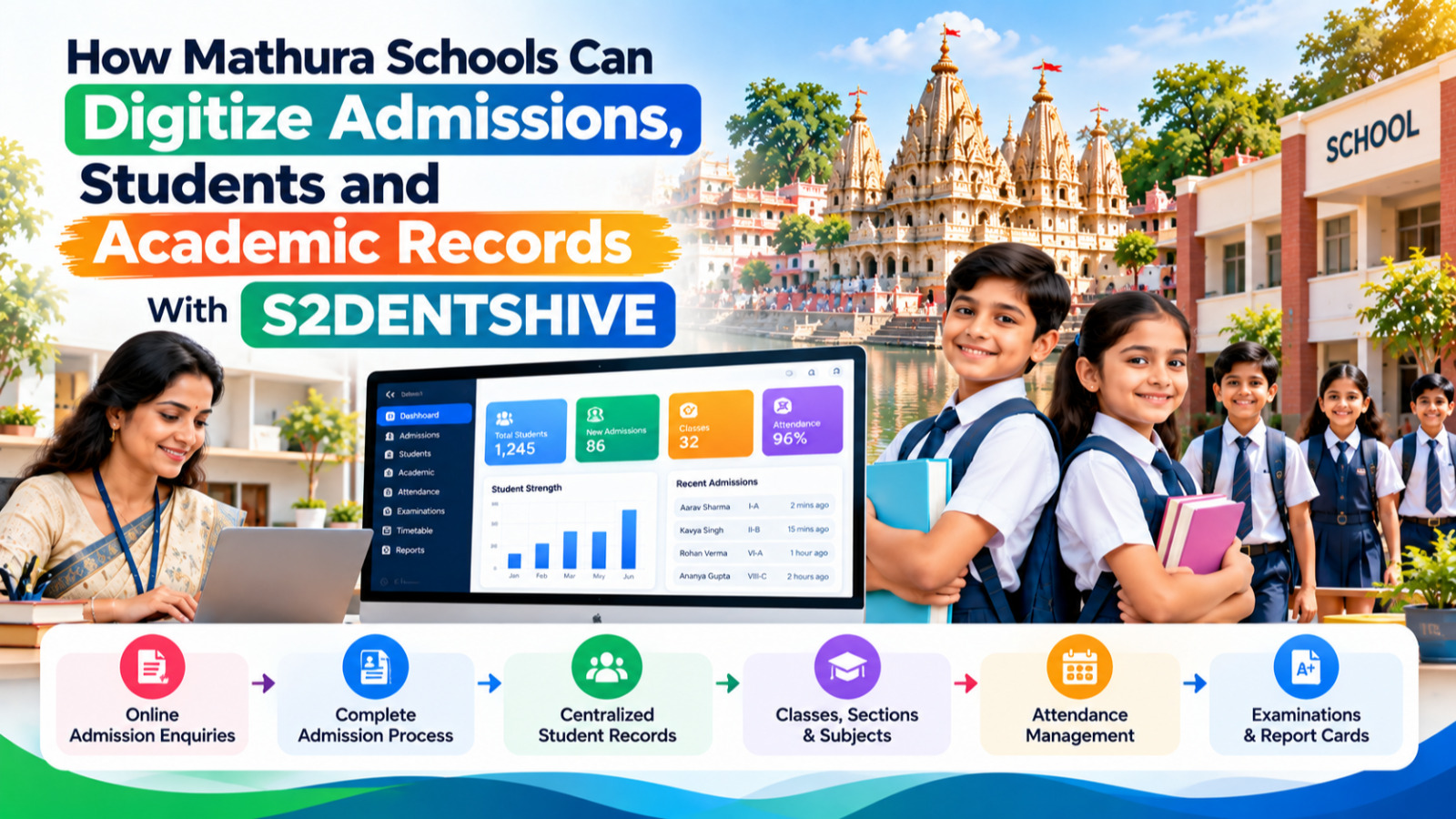
With S2DENTSHIVE, schools can bring admissions, student management and academic records into one centralized School ERP platform.
Why Schools Need Digital Student Records
Student information is used by almost every department in a school.
The admission team needs it when enrolling students. Teachers use it for academic activities. The accounts department needs it for fees. The examination department uses it for marks and report cards. Transport and hostel teams may also require relevant student information.
When the same information is maintained separately by different departments, several problems can occur:
- Duplicate data entry
- Outdated information
- Missing records
- Difficulty finding old documents
- Manual reporting
- Repeated data entry
- Communication gaps between departments
A centralized student management system can help schools maintain a more consistent digital record.
From Admission Enquiry to Complete Student Profile
The student journey starts before admission.
A parent may initially contact the school for information, submit an enquiry and later complete the admission process.
Traditionally, these stages may be recorded in separate registers.
A digital school ERP can connect them into a more structured workflow:
Admission Enquiry → Application → Admission → Student Profile → Class Assignment → Academic Records
This gives schools a more complete digital view of the student's journey.
1. Digitize Admission Enquiries
The admission process often begins with enquiries from parents.
During admission season, a school may receive a large number of enquiries through different channels.
Managing these manually can make follow-ups difficult.
S2DENTSHIVE can help schools organize admission-related information such as:
- Student name
- Parent/guardian information
- Contact details
- Admission enquiry
- Class requirement
- Follow-up information
- Admission status
- Related documents
This provides the admission team with a structured digital record instead of relying entirely on notebooks and spreadsheets.
2. Manage the Admission Process Digitally
Once an enquiry becomes a prospective admission, the school needs to collect additional information.
A centralized admission system can help administrators manage the transition from enquiry to student registration.
Schools can organize information related to:
- Student details
- Parent details
- Guardian information
- Documents
- Previous school information
- Class and section
- Admission status
This can reduce repetitive data entry and make the admission process more systematic.
3. Create a Centralized Student Profile
Once a student is admitted, their information becomes part of the school's long-term records.
Instead of maintaining separate files for different departments, S2DENTSHIVE provides a centralized environment for student information.
A student profile can include information related to:
- Personal details
- Guardian details
- Class
- Section
- Academic information
- Attendance
- Fees
- Examination records
- Documents
- Other school-related information
This makes the student's information easier to manage throughout their academic journey.
4. Reduce Duplicate Student Data
One of the common problems with manual school administration is entering the same information multiple times.
For example, student information may be entered separately for:
- Admission
- Fee records
- Attendance
- Examination
- Transport
- ID cards
- School reports
This creates additional work and increases the possibility of inconsistencies.
With centralized student records, the school can maintain a common source of information for different school operations.
5. Organize Classes and Sections Digitally
After admission, students need to be assigned to the appropriate class and section.
As schools grow, managing class structures manually becomes more complicated.
S2DENTSHIVE can help schools organize:
- Classes
- Sections
- Student assignments
- Class teachers
- Subjects
- Academic sessions
This creates a structured academic environment for administrators and teachers.
6. Digitize Academic Information
Academic records are more than examination marks.
They can include information related to:
- Subjects
- Classes
- Sections
- Teachers
- Timetables
- Attendance
- Examinations
- Marks
- Grades
- Report cards
Keeping these records digitally allows schools to organize academic information in a structured way.
7. Connect Students With Their Subjects
Every student belongs to an academic structure that includes subjects and teachers.
Managing these relationships manually can become difficult when schools have many classes and sections.
A digital academic management system can help schools organize subject assignments and connect relevant academic information with classes and students.
This provides administrators with a clearer understanding of the school's academic structure.
8. Manage Timetables Digitally
Timetable management involves coordinating classes, sections, subjects and teachers.
A school may have hundreds of timetable entries across different classes.
Digital timetable management can help schools organize this information and reduce dependence on printed schedules and manually maintained files.
With centralized academic information, timetable data can become part of the overall school ERP environment.
9. Maintain Digital Attendance Records
Attendance is one of the most frequently updated student records.
Teachers need to record attendance regularly, while school management may need attendance reports later.
A digital attendance system provides a more organized alternative to paper registers.
S2DENTSHIVE can help schools maintain student attendance records and generate relevant information for administration.
The platform can also support modern attendance approaches such as camera-based attendance, helping schools explore more automated attendance workflows.
10. Digitize Examination Records
Examination data is another important component of a student's academic history.
Schools need to manage:
- Examinations
- Subjects
- Marks
- Grades
- Assessment records
- Student performance
- Report cards
When examination records are maintained manually, preparing consolidated reports can take considerable time.
A centralized digital system can help organize examination information against student records.
11. Simplify Report Card Preparation
Report cards bring together information from different academic activities.
Marks, grades and other relevant academic information need to be accurately associated with the correct student.
S2DENTSHIVE can help schools organize examination and report card information digitally.
This can reduce manual compilation and make academic records easier to access.
12. Keep Academic Records Accessible
A student's academic journey can span many years.
Schools may need historical information for:
- Previous academic performance
- Attendance
- Examination results
- Class history
- Student records
- Administrative requirements
Paper files can take up physical space and may be difficult to search.
Digital records provide a more convenient way to organize and retrieve information when required.
13. Connect Admissions With Academic Management
One of the biggest benefits of an ERP is that admission information does not have to remain isolated from academic information.
Once a student is admitted, relevant information can flow into the student's broader school record.
For example:
Admission → Student Profile → Class → Section → Subjects → Attendance → Examination → Report Card
This creates a connected student lifecycle.
14. Make Student Information Useful Across Departments
Student information is relevant to more than the academic department.
Depending on the student's requirements, authorized information may be relevant to:
Accounts
For fee management.
Teachers
For attendance and academic activities.
Examination Department
For marks and results.
Transport Department
For transportation records.
Hostel Department
For accommodation records.
Administration
For student documentation and general management.
School Management
For reports and institutional insights.
A centralized ERP can help different departments work with relevant information without maintaining completely separate student databases.
15. Improve Parent Information Management
Parents and guardians are an important part of student administration.
Schools need accurate information for communication regarding:
- Attendance
- Fees
- Homework
- Notices
- Examinations
- Events
- Other school activities
Centralized student and guardian records can help schools maintain more reliable communication information.
16. Reduce Paperwork During Admissions
Admission season can generate a significant amount of paperwork.
Forms, student documents, parent information and other records may occupy considerable physical space.
Digitizing admission information can help schools reduce dependence on paper-based workflows.
Instead of searching through multiple files, administrators can access relevant student information through the school's digital system.
17. Help School Management Understand Student Strength
Student records can also provide useful information for school management.
Management may want to understand:
- Total student strength
- Class-wise student numbers
- Section-wise distribution
- New admissions
- Student movement
- Academic performance
- Attendance trends
When student data is centralized, generating such information becomes more organized.
This can help management plan classrooms, staff requirements and other resources.
18. Protect Against Information Loss
Paper records can be damaged, misplaced or become difficult to locate over time.
Digital records can provide schools with a more structured approach to maintaining information.
With appropriate access controls, backups and security practices, schools can create a more reliable environment for their important student records.
19. Reduce Administrative Work for Teachers
Teachers already spend significant time on classroom activities.
Repeatedly maintaining the same student information in different registers can add to their administrative workload.
Digital systems can help teachers manage relevant activities more efficiently, including:
- Attendance
- Class information
- Subjects
- Academic records
- Examination-related activities
This allows teachers to spend more time on teaching and student development rather than repetitive paperwork.
20. Give Mathura Schools a Digital Student Lifecycle
A modern school ERP can transform the way a school manages a student's complete journey.
Instead of treating every activity as a separate process, schools can create a connected lifecycle:
Step 1: Enquiry
A parent expresses interest in admission.
Step 2: Admission
The student's information is captured digitally.
Step 3: Student Profile
A centralized student record is created.
Step 4: Class Assignment
The student is assigned to the appropriate class and section.
Step 5: Academic Management
Subjects, teachers and timetable information are organized.
Step 6: Attendance
Daily attendance becomes part of the student's digital record.
Step 7: Examination
Marks and grades are recorded digitally.
Step 8: Report Card
Academic performance is consolidated into reports.
Step 9: Continuing Records
The student's information remains available throughout the academic journey.
This is the advantage of managing the school through one connected platform.
S2DENTSHIVE for Digital School Administration in Mathura
S2DENTSHIVE is designed to help schools move beyond individual software tools and adopt a centralized approach to school management.
Along with admissions and student records, the platform supports several school operations, including:
- Student Management
- Admission Management
- Fee Management
- Attendance
- Staff Management
- Academic Management
- Timetable Management
- Examination Management
- Report Cards
- Transport Management
- Hostel Management
- Library Management
- Inventory Management
- Events and Activities
- Communication
This means schools can build their digital administration around one connected ecosystem.
Why Digitization Matters for Growing Schools
A school may begin with a few registers and spreadsheets.
But as the student population increases, the amount of information increases as well.
More students mean more:
Admissions → Records → Classes → Attendance → Subjects → Exams → Results
Managing this manually becomes increasingly difficult.
Digitization allows schools to build systems that can support growth without increasing paperwork at the same rate.
From Paper Files to Digital Student Records
The transformation can be simple to understand:
| Traditional Approach | Digital Approach |
|---|---|
| Paper admission forms | Digital admission records |
| Student registers | Centralized student profiles |
| Separate spreadsheets | Connected student data |
| Paper attendance | Digital attendance |
| Manual mark sheets | Digital examination records |
| Manual report preparation | Structured report cards |
| Physical document search | Faster digital access |
| Department-wise records | Centralized school ERP |
The objective is not simply to eliminate paper.
It is to make school information more organized, accessible and connected.
Why S2DENTSHIVE Can Be Valuable for Mathura Schools
Schools in Mathura looking to modernize their administration can benefit from bringing student-related processes together.
S2DENTSHIVE can help schools create a centralized digital environment where:
- Admissions are organized
- Student information is centralized
- Academic structures are managed digitally
- Attendance can be recorded
- Examinations can be managed
- Report cards can be organized
- School management can access relevant information
This provides a foundation for broader school digital transformation.
The Future of Student and Academic Management
The future of school administration is moving toward connected digital records.
Schools will increasingly need systems that can connect the complete student journey rather than managing each activity independently.
For a school, the ideal digital ecosystem should allow information to move logically from:
Admission → Student → Class → Academic Activities → Attendance → Examination → Report Card
S2DENTSHIVE follows this centralized school management approach.
Conclusion
Digitizing admissions and academic records is not simply about replacing paper forms with computers.
It is about creating a connected digital student lifecycle.
For schools in Mathura, S2DENTSHIVE provides a centralized platform to manage admissions, student profiles, classes, subjects, attendance, examinations and academic records while connecting these functions with the wider school management ecosystem.
By moving from scattered registers and spreadsheets to a centralized School ERP, schools can work toward:
- Less paperwork
- Reduced duplicate data entry
- Better student information management
- Easier academic record access
- More organized admissions
- Improved administrative coordination
- Better management visibility
From Admission to Graduation, Keep Every Student Record Connected.
S2DENTSHIVE helps schools in Mathura build a more organized, connected and digitally managed student and academic ecosystem.
Comments (0)
Share your thoughts or ask a question about this article.
Leave a Comment