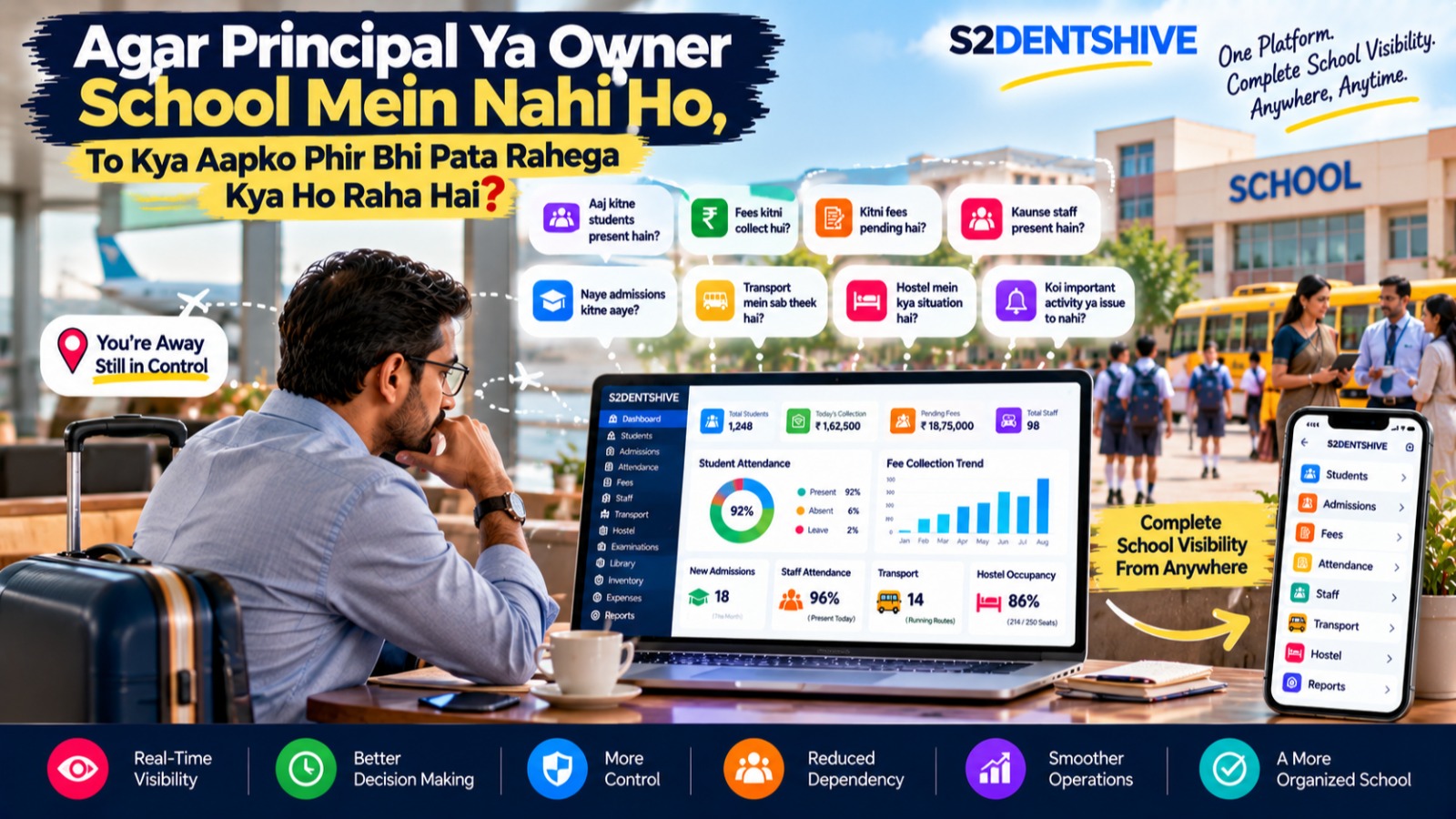

Agar aap school mein physically present nahi hain, to kya aapko phir bhi pata hai ki aaj kitne students absent hain, kitni fees collect hui, kitni pending hai, kaunse staff members present hain, kitne admissions aaye aur school mein kya important activity chal rahi hai?
Ye ek simple question lag sakta hai.
Lekin school owner ke liye iska answer bahut important hai.
Kyunki school management ka matlab sirf school campus mein present rehna nahi hai.
Aaj ke time mein ek school owner ko school ke andar ho rahi important activities ki clear visibility chahiye — chahe woh school mein ho, kisi meeting mein ho, kisi doosre branch mein ho ya kisi personal kaam se bahar ho.
Problem tab shuru hoti hai jab school ki information alag-alag registers, Excel files, WhatsApp messages, staff reports aur verbal updates mein scattered ho.
Phir owner ko har chhoti-badi information ke liye kisi ek staff member ko call karna padta hai.
“Aaj attendance kaisi hai?”
“Fees kitni collect hui?”
“Kitni fees pending hai?”
“Kaunse teachers absent hain?”
“Naye admissions kitne aaye?”
“Transport mein koi issue hai?”
“Hostel mein kya situation hai?”
Aur kabhi-kabhi answer milta hai:
“Sir, check karke batate hain.”
Yahi gap ek modern school management system solve kar sakta hai.
With S2DENTSHIVE, the objective is simple:
School mein aap present na bhi ho, phir bhi school ki important information aapke control mein honi chahiye.
School Owner Ko Har Time School Mein Rehna Zaroori Kyun Nahi Hona Chahiye?
Ek growing school ke owner ya principal ke paas sirf ek responsibility nahi hoti.
Unhe academics dekhna hota hai.
Staff manage karna hota hai.
Parents ki concerns handle karni hoti hain.
Fees collection monitor karni hoti hai.
Admissions track karne hote hain.
Expenses dekhne hote hain.
Transport, hostel, inventory aur other operations par bhi nazar rakhni hoti hai.
Agar school ka pura management system is assumption par depend karta hai ki “owner school mein hai to sab control mein hai”, to system scalable nahi hai.
A good management system should work even when the owner is not physically present.
The real question should be:
“Agar main school mein nahi hoon, kya mujhe important information automatically available rahegi?”
A modern School ERP Software isi visibility ko possible banata hai.
Physical Presence Aur Management Control Alag Cheezein Hain
School mein physically present hona aur school ko effectively control karna do alag cheezein hain.
Maan lijiye school owner ek din school nahi aa paya.
Traditional system mein kya hota hai?
Morning mein attendance register check karne ke liye call.
Fees collection ke liye accounts team ko call.
Admissions ke liye admission desk ko call.
Staff attendance ke liye HR ya admin ko call.
Transport ke liye transport coordinator ko call.
Kisi student issue ke liye coordinator ko call.
End of the day report ke liye WhatsApp par updates.
Is approach mein information available hai, lekin connected nahi hai.
Digital system mein owner ko har department ke liye alag-alag person se information collect karne ki zaroorat kam ho sakti hai.
Important data ek centralized platform par available hota hai.
Information staff ke paas locked nahi rehti.
Management ke paas visible rehti hai.
“School Mein Kya Ho Raha Hai?” Ka Answer Data Se Milna Chahiye
Ek school owner ko har activity personally verify karna possible nahi hai.
Isliye management ke liye reports aur dashboards important ho jaate hain.
For example, agar aap subah school nahi ja pa rahe hain, to aapko basic operational picture dekhni chahiye:
-
Student attendance
-
Staff attendance
-
Fee collection
-
Pending fees
-
New admissions
-
Admission enquiries
-
Daily expenses
-
Examination activities
-
Homework or academic updates
-
Transport information
-
Hostel information
-
Important events
-
School communication
Is information ko ek jagah dekh paana school management ko significantly easier bana deta hai.
Student Attendance: Kitne Students School Mein Hain?
Attendance school operations ka one of the most important indicators hai.
Owner ke liye sirf attendance mark hona important nahi hai.
Important hai:
Aaj attendance percentage kya hai?
Kaunsi class mein attendance low hai?
Kitne students absent hain?
Kya kisi particular class mein unusual absenteeism hai?
With a centralized school management platform, attendance information can become part of the management dashboard.
S2DENTSHIVE mein student attendance management ke saath modern attendance workflows ko centralize kiya ja sakta hai.
Isse owner ko har class teacher ko individually call karke attendance status poochne ki zaroorat nahi padti.
Staff Attendance: Teachers Aur Employees Ki Situation Kya Hai?
School ka daily operation staff ke bina possible nahi hai.
Lekin owner ke liye har morning manually check karna difficult ho sakta hai ki:
-
Kaun present hai?
-
Kaun absent hai?
-
Kaun late hai?
-
Kis department mein staff shortage hai?
-
Kya substitute arrangement ki zaroorat hai?
Digital staff attendance information management ko better visibility deti hai.
Iska benefit sirf attendance record tak limited nahi hai.
It can help management understand staff availability and daily operational readiness.
Fees Collection: Aaj Kitna Paisa Collect Hua?
School owner ke liye financial visibility extremely important hai.
Suppose aap school mein nahi hain.
Aapko pata hona chahiye:
Aaj ki fee collection kitni hui?
Kitni fees pending hai?
Kaunsi classes mein pending amount zyada hai?
Kaunse students overdue hain?
Recent payments kya hain?
Agar iska answer sirf register ya accounts department ke paas hai, to management visibility weak hai.
A centralized fee management system owner ko fee collection aur pending fee information ko better way mein understand karne mein help karta hai.
S2DENTSHIVE fee management ko student records aur broader school operations ke saath connect karne ka approach follow karta hai.
Sirf “Fees Pending Hai” Enough Nahi Hai
Imagine accounts team aapko batati hai:
“Sir, fees pending hai.”
Next question kya hoga?
“Kitni?”
Phir:
“Kis class ki?”
“Kitne students ki?”
“Kitne time se pending hai?”
“Parents ko reminder gaya?”
“Payment link share hua?”
“Last payment kab hua tha?”
Agar har answer ke liye alag register, Excel sheet ya staff member ki zaroorat hai, to management slow ho jata hai.
A good school management system should turn a general statement like:
“Fees pending hai.”
into useful information:
“Exactly kitni pending hai, kahan pending hai aur collection improve karne ke liye kya action lena hai.”
Admissions: School Mein Kitne New Enquiries Aa Rahe Hain?
School growth ka ek important indicator admissions hai.
Owner ko pata hona chahiye:
-
New enquiries kitni hain?
-
Kitne parents contacted hue?
-
Kitne campus visits hue?
-
Kitne admissions converted hue?
-
Kaunsi classes mein demand zyada hai?
-
Kaunse enquiries follow-up ke liye pending hain?
Agar admission data ek notebook ya individual staff member ke phone mein hai, to owner ko complete picture milna difficult ho sakta hai.
With centralized admission management, enquiry se admission tak ka journey better track kiya ja sakta hai.
Iska matlab owner ko school mein physically present rehkar admission register check karne ki zaroorat nahi.
School Owner Ko Staff Ke Updates Par Completely Dependent Nahi Hona Chahiye
Staff reports important hain.
Lekin management system ka purpose staff ko replace karna nahi hai.
Purpose hai information ko structured aur accessible banana.
Agar owner ko kisi specific report ke liye baar-baar message karna pad raha hai:
“Report bhejna.”
“Attendance bhejna.”
“Fees ka screenshot bhejna.”
“Admissions ka update bhejna.”
“Staff attendance bhejna.”
to system abhi bhi largely person-dependent hai.
A centralized School Management System information ko process ke saath connect karta hai.
This creates a healthier management structure:
Staff manages the work.
System records the work.
Management sees the information.
Principal Ke Liye Bhi Same Challenge Hai
Ye problem sirf school owners ki nahi hai.
Principal ko bhi daily hundreds of operational decisions lene padte hain.
Agar principal kisi meeting mein hai, kisi event mein busy hai ya school ke kisi aur area mein engaged hai, to unhe har department se manual update lena inefficient ho sakta hai.
A centralized dashboard principal ko important information quickly understand karne mein help kar sakta hai.
For example:
Morning View
-
Student attendance
-
Staff attendance
-
Important notices
-
Scheduled activities
Mid-Day View
-
Attendance changes
-
Admissions
-
Fee collections
-
Operational issues
End-of-Day View
-
Total collection
-
Attendance summary
-
Important activities
-
Pending actions
-
Reports
Is tarah school management reactive hone ke bajay more structured ho sakta hai.
One School, Many Departments — But One View
School ke andar multiple departments hote hain.
Admissions
Students
Staff
Attendance
Fees
Examinations
Transport
Hostel
Library
Inventory
Expenses
Communication
Events
Problem tab hoti hai jab har department ka data alag system mein ho.
Then the owner sees fragments instead of the complete picture.
A centralized platform ka real advantage yahi hai:
Different departments. One connected system.
S2DENTSHIVE ka objective school ke multiple operational areas ko ek centralized digital platform ke through connect karna hai.
What If Something Goes Wrong When You Are Not There?
Ye question bhi important hai.
Suppose owner school se bahar hai.
Aur kisi class mein attendance suddenly low hai.
Ya kisi department mein staff availability issue hai.
Ya fees collection expected level par nahi hai.
Ya admission enquiries ka follow-up pending hai.
Ya expenses increase ho rahe hain.
Agar information immediately visible nahi hai, to issue tab pata chal sakta hai jab problem already large ho chuki ho.
Better visibility ka benefit sirf reporting nahi hai.
It can help management identify situations earlier.
School Data Sirf Record Nahi, Decision-Making Tool Hai
Bahut schools mein software ka use mainly data entry ke liye hota hai.
Student add karo.
Fee entry karo.
Attendance mark karo.
Staff record maintain karo.
Lekin modern school management software ka bigger purpose hai:
Data ko decision-making mein useful banana.
For example:
Attendance data → attendance trend samajhne mein help kar sakta hai.
Fee data → collection aur pending amount samajhne mein help karta hai.
Admission data → school growth pipeline samajhne mein help karta hai.
Staff data → workforce availability understand karne mein help karta hai.
Expense data → operational spending visibility provide karta hai.
Jab ye information connected hoti hai, school owner ko better overall picture milti hai.
WhatsApp Updates Aur Digital Dashboard Mein Difference
WhatsApp useful hai.
Lekin WhatsApp school management system nahi hai.
Aapko WhatsApp par daily updates mil sakte hain:
“Sir, 8th class mein 4 students absent hain.”
“Sir, today ₹85,000 fees collected.”
“Sir, 3 new admissions aaye.”
Lekin kuch din baad historical comparison ka kya?
Last month kitna collection tha?
Last week attendance kya thi?
Kaunsi class mein pending fees continuously high hai?
Kaunse month mein admissions increase hue?
Yahan structured digital data important ho jata hai.
Message information deta hai.
Management system information ko organize karta hai.
Owner Ko “Trust Me” Nahi, “Show Me” Chahiye
School management mein trust important hai.
Lekin good systems trust ko replace nahi karte — trust ko stronger banate hain.
A staff member says:
“Sir, fees collection achhi hai.”
Instead of relying only on the statement, management can look at the actual collection data.
Someone says:
“Attendance normal hai.”
Management can review the attendance information.
Someone says:
“Admissions achhe aa rahe hain.”
Management can check enquiry and admission numbers.
This creates a more transparent management environment.
Remote School Management Ka Matlab Sirf Mobile App Nahi Hai
Remote management ka matlab sirf ye nahi ki school ka software mobile par open ho jaye.
Real remote management means:
Important information should remain accessible even when you are physically away from the campus.
You should be able to understand the school without asking ten people for ten different updates.
That's where centralized school management becomes valuable.
S2DENTSHIVE: School Ko Ek Centralized Management View Dene Ki Approach
S2DENTSHIVE is designed around the idea that school operations should not remain scattered across registers, spreadsheets, separate applications and disconnected workflows.
The platform brings multiple areas of school management together, including:
-
Student management
-
Admissions
-
Staff management
-
Student attendance
-
Staff attendance
-
Fees management
-
Fee reminders
-
Online payment links
-
Examinations
-
Marks and report cards
-
Timetable
-
Transport management
-
Hostel management
-
Library management
-
Inventory management
-
Expenses
-
Events
-
Communication
-
Reports
-
Live classes
The benefit is not simply having many features.
The bigger benefit is having connected information in one place.
Imagine Starting Your Morning With One Clear View
Imagine you are not at school today.
Instead of calling different people, you open your school management dashboard.
You can quickly understand:
Students: Attendance status kya hai?
Staff: Kaun present hai?
Fees: Aaj kitna collection hua?
Pending: Kitna amount outstanding hai?
Admissions: New enquiries aur admissions kitne hain?
Academics: Exams, timetable ya academic activities mein kya important hai?
Operations: Koi important activity ya issue hai?
Ab aapko school manage karne ke liye physically school mein hona compulsory nahi lagta.
Because information is available even when you are away.
The Real Goal: School Ko Person-Dependent Se System-Driven Banana
Har school mein experienced staff important hota hai.
Lekin agar ek particular person ke paas hi complete information hai, to organization vulnerable ho sakti hai.
What happens if that person is:
-
On leave?
-
Busy?
-
Unavailable?
-
Transferred?
-
No longer working with the school?
A system-driven school ensures that important operational information remains part of the institution rather than remaining with an individual.
This is one of the biggest advantages of digital school management.
A School Owner Should Be Able to Step Away
Ye line simple hai, lekin important hai:
A school owner should be able to step away from the campus without stepping away from the information.
Owner ka role har chhoti activity personally manage karna nahi hona chahiye.
Owner ka role hona chahiye:
-
Direction set karna
-
Performance understand karna
-
Important decisions lena
-
Problems identify karna
-
Growth opportunities dekhna
-
School ko improve karna
Aur iske liye reliable information zaroori hai.
Final Question: Agar Aap Kal School Na Jayein, To Kya Aapko Pata Rahega?
Ab ek simple test kijiye.
Imagine kijiye ki kal aap school nahi ja rahe.
Can you answer these questions without making multiple phone calls?
1. Aaj kitne students present hain?
2. Staff attendance kya hai?
3. Aaj kitni fees collect hui?
4. Total pending fees kitni hai?
5. New admission enquiries kitni hain?
6. Kitne admissions convert hue?
7. Koi important academic activity hai?
8. Koi major operational issue hai?
9. Expenses mein kya hua?
10. Kya school mein aaj kuch aisa hua jiske baare mein mujhe immediately pata hona chahiye?
Agar in questions ka answer easily available hai, your school has better management visibility.
Agar har answer ke liye kisi na kisi person ko call karna padta hai, there may be an opportunity to improve your management system.
School Management Ka Future: Presence Se Zyada Visibility
A modern school ko manage karne ke liye sirf physical presence enough nahi hai.
Visibility matters.
Data matters.
Connected systems matter.
Timely information matters.
School owner ya principal school mein ho ya nahi, important operations ki visibility available honi chahiye.
That is the real value of centralized school management.
With S2DENTSHIVE, schools can bring students, staff, admissions, attendance, fees, academics, operations and other important workflows into one centralized platform.
Because ultimately, the goal is not to sit in the school all day to know what is happening.
The goal is to build a system where you can know what is happening even when you are not there.
Comments (0)
Share your thoughts or ask a question about this article.
Leave a Comment